According to the China Photovoltaic Industry Association, my country is projected to begin generating a large volume of retired photovoltaic (PV) modules in 2025; the peak of PV module waste is expected after 2030, reaching approximately 18GW, or about 1.4 million tons; and by 2040, the cumulative waste will reach 253GW, or about 20 million tons. Facing this impending peak in PV module retirement, how prepared is my country’s PV module recycling program? What challenges remain to be overcome in the industry?
Huge Development Potential
PV module recycling refers to the dismantling of PV modules to achieve material recycling and reuse. The core components of PV modules mainly include solar cells, glass, EVA (ethylene-vinyl acetate copolymer), and backsheets.
“Currently, waste PV modules mainly come from power plants and production facilities. Although some are transported, the quantity is very small,” said Xu Junyu, project specialist at the Secretariat of the PV Recycling Industry Development Cooperation Center. Some of these waste modules end up in the hands of PV recycling companies, while others are temporarily stored in warehouses until conditions are suitable for dismantling and processing.
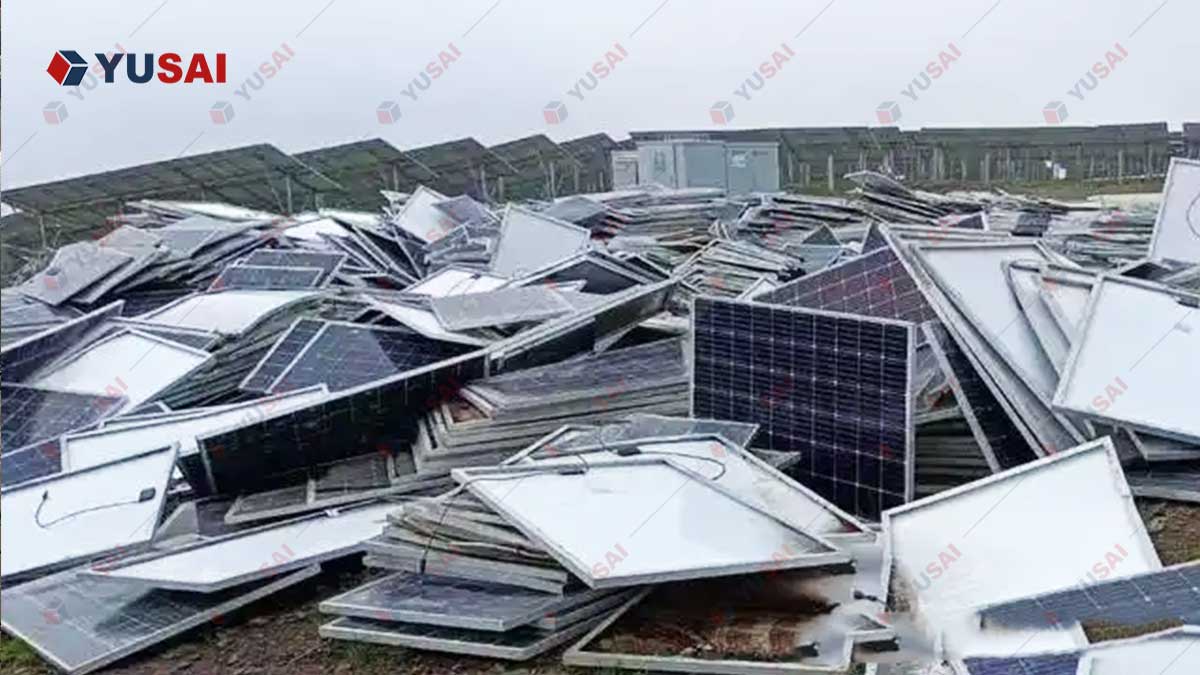
Retired photovoltaic (PV) modules, as a new type of solid waste, offer not only considerable circular economy benefits but also significant environmental benefits through their harmless treatment and efficient recycling. “From a market perspective, PV module recycling has enormous potential and significant benefits. It is estimated that this market size is expected to exceed 100 billion yuan,” said Yu Xiaoming, senior investment consultant at Jufeng Investment Consulting.
At the national level, efforts to promote PV module recycling have begun. In 2023, the National Development and Reform Commission and other departments issued the “Guiding Opinions on Promoting the Recycling of Retired Wind Power and Photovoltaic Equipment,” which clearly stated the need to actively build a recycling system for wind power and photovoltaic equipment covering green design, standardized recycling, high-value utilization, and harmless disposal, completing the final link in the green, low-carbon, and circular development of the wind power and photovoltaic industry chain, and helping to achieve carbon peaking and carbon neutrality. Currently, PV module recycling is entering an accelerated phase. Recently, the group standard “Technical Specification for Recycling and Disposal of Retired Photovoltaic Modules,” drafted by the China National Resources Recycling Association and Xinyuan Jinwu (Beijing) Technology Co., Ltd., passed technical review. This standard aims to standardize the recycling and disposal process of retired PV modules and promote the healthy development of the industry.
As the recycling market reaches a certain scale, the number of participants in the photovoltaic (PV) recycling industry is constantly increasing. An employee of Jinko Solar Co., Ltd. stated that Jinko Solar focuses on two aspects in its recycling development: first, the iterative upgrading of technology and equipment to build technical reserves for compatible recycling of different module models; second, the construction of recycling channels to maximize the value of recycled materials through Jinko Solar’s own supply chain advantages. State Power Investment Corporation (SPIC) Yellow River Company has been tackling key technologies for the industrialization and localization of equipment for crystalline silicon PV module recycling, developing complete process technology and industrial equipment for PV module recycling. In December 2024, the high-efficiency integrated process technology and localized equipment for crystalline silicon PV module recycling, jointly developed by SPIC Yellow River Company and SPIC PV Industry Innovation Center, were selected for the fourth batch of major technological equipment lists in the energy sector by the National Energy Administration.
Insufficient Market Supply
Currently, there are many companies offering on-site PV module recycling services. However, most of these companies are small-scale and can only undertake local business.
“Collecting photovoltaic panels from other provinces is not cost-effective. For example, transporting each panel from Guangdong to Suzhou costs tens of yuan, which doesn’t even cover the overall cost. We generally only accept panels that are at least 500 pieces, enough to fill a truck,” said a representative from a recycling company in Kunshan, Jiangsu. After collection, the company dismantles the panels, selling valuable materials like silicon to companies that need them.
Liang Zhenpeng, chief consultant at Zhifan Coast, believes that profitability is the current predicament facing the photovoltaic module recycling industry. On the one hand, the large-scale retirement period has not yet arrived, resulting in insufficient market supply and the lack of a large-scale industrial chain. The costs of dismantling, transporting, and recycling used modules are high. On the other hand, some companies, due to technological limitations, use relatively simple processing methods, resulting in less reusable material and significant resource waste.
Photovoltaic modules have a complex structure containing various materials, and the separation and recycling of these materials requires efficient technical support. “Especially the processing of fluorinated backsheets, removal of EVA layers, and recovery of precious metals present difficulties,” said Xiang Weili, Executive Director of Sullivan Greater China. He explained that while thermal treatment can achieve material separation, it generates harmful gases, while chemical solvent methods face the problem of treating organic waste liquids.
It is understood that existing technologies in photovoltaic module dismantling mainly include physical methods, pyrolysis chemical methods, and solvent chemical methods. Physical methods are relatively simple to operate, but the purity of the separated materials is relatively low. Chemical methods, while yielding components with higher purity than physical methods, consume other materials during the process. To improve photovoltaic recycling efficiency, combining physical and chemical methods in a certain way has become an important direction for the development of the photovoltaic recycling industry.
Currently, the development of photovoltaic module recycling and processing technologies mainly focuses on crystalline silicon photovoltaic modules. The key to recycling and utilizing waste photovoltaic modules lies in recovering rare metals and valuable materials, reducing resource waste, and minimizing environmental pollution. Harmful substances such as lead, sulfuric acid, cadmium, and tin, if not properly handled, can have serious environmental impacts.
Currently, the photovoltaic (PV) module recycling industry is plagued by illegal recycling and dismantling practices. Small-scale recycling workshops, exempt from environmental processing costs, can offer higher prices for used modules, making it difficult for legitimate recycling companies to profit. This “bad money drives out good” mentality disrupts market order.
“To reverse the crude and simplistic processing model of small workshops, PV module recycling companies need to possess the necessary qualifications and technical capabilities. Recycling and dismantling must follow scientific and standardized processes to ensure reliability and safety,” said Liang Zhenpeng.
The lack of policy and standards constraints is also a significant factor hindering the development of the PV module recycling industry. In terms of standards and assessment, a comprehensive standard system for module recycling and processing is lacking, and supporting systems such as market guidance and incentive policies need further improvement. “The definition of PV module obsolescence is unclear. There are still some gaps in technology, standards, and management policies in the cycle from obsolescence to dismantling, decomposition, and reuse,” a Jinko Solar employee told reporters.
Unblocking Recycling Channels
To achieve the healthy development of the PV module recycling industry, unblocking recycling channels is urgently needed.
The “Guiding Opinions on Promoting the Recycling of Retired Wind and Solar Power Equipment” proposes that by 2025, a basic responsibility mechanism for the disposal of retired equipment from centralized wind farms and solar power stations will be established, relevant standards and specifications for the recycling of retired wind and solar power equipment will be further improved, and breakthroughs will be achieved in key technologies for resource recycling. By 2030, a complete recycling technology system for wind and solar power equipment will be basically mature, resource recycling models will be more sound, resource recycling capacity will be effectively matched with the scale of retirement, standards and specifications will be more complete, the level of resource recycling in the wind and solar power industry will be significantly improved, and a number of industrial clusters for the recycling of retired wind and solar power equipment will be formed.
While promoting the development of the solar photovoltaic industry, various regions are also actively exploring development paths for the solar module recycling industry, promoting the green development of the solar recycling industry through policy guidance, technological innovation, and industrial collaboration.
Establishing a sound recycling system is crucial in this process. Xiang Weili suggests supporting photovoltaic (PV) equipment manufacturers in establishing regional PV module recycling warehouses through various models, including independent recycling, joint recycling, or commissioned recycling. He also recommends adopting an online monitoring model of “Internet + PV module recycling” to track and statistically analyze the annual number of PV modules retired from each power generation company. Furthermore, he encourages the application of big data, IoT, and cloud computing technologies in the recycling system to make the recycling process measurable, reportable, and verifiable.
Furthermore, the active participation of PV companies is crucial. “With the development of the PV industry and technological advancements, more and more companies are beginning to focus on the full lifecycle management of PV modules and are attempting to establish corresponding recycling systems,” said Yu Fenghui, a senior researcher at Pangu Think Tank.
Xu Junyu believes that support should be given to PV end-user owners to lead the establishment of new recycling systems for waste PV products. For large-scale centralized PV power plants, a reverse logistics recycling system should be established based on sales, logistics, and operation and maintenance networks. For distributed PV, pilot independent recycling programs should be conducted in industrial parks, towns, and transportation hubs, utilizing “Internet +” to improve the standardized recycling rate.
“With continuous technological advancements and increasing market demand, industry concentration will gradually increase, which will enable relevant enterprises to achieve more significant results in technological innovation, resource utilization, and environmental protection, thus promoting the sustainable development of the photovoltaic industry.”