
Solar Panel Aluminum Frame Removing Machine
— Solar Panel Aluminum Frame Removing Machine
The solar panel aluminum frame removing machine (PV panel de-framing machine) is the essential first-stage pre-treatment equipment in a modern solar panel recycling plant. It cleanly separates the aluminum frame from end-of-life photovoltaic modules without damaging the tempered glass or solar cells, producing two high-value outputs: pure aluminum frame scrap ready for smelting, and an intact panel core ready for glass, silicon and metal recovery. Hydraulic-driven, PLC-controlled, and available in semi-automatic and fully automatic models from 40 to 120 panels per hour.
Product Overview
Every end-of-life solar panel begins its recycling journey with frame removal. The aluminum frame accounts for roughly 10% of a PV module’s total weight, and it is the single most valuable non-glass component — yet in manual dismantling it is often scratched, mixed with glass shards, or left for landfill. Our solar panel aluminum frame removing machine solves this with hydraulic precision: a pressing plate clamps the panel firmly on the work platform while four-sided pulling cylinders break the corner joints and peel the frame off cleanly, in one automated cycle of 10–30 seconds.
The machine sits at the front of the solar panel recycling production line, immediately after junction box removal and before glass removal, crushing and sorting. Because it removes the frame without crushing or contamination, every downstream stage — glass recovery, silicon cell recovery, copper ribbon recovery, and silver paste extraction — starts with cleaner, higher-purity input material.
With global PV installations entering their end-of-life phase, the world faces a wave of decommissioned solar modules. According to the International Renewable Energy Agency (IRENA), cumulative global PV panel waste could reach 60–78 million tonnes by 2050. In the EU, the WEEE Directive 2012/19/EU has required solar panel recycling since 2012, and similar extended-producer-responsibility regulations are expanding across the US, Australia, India and Southeast Asia. Investing in professional solar panel frame removal equipment today positions a recycling business to capture this fast-growing waste stream.
Recycling Value Analysis
Why remove the frame first? The aluminum frame is the cleanest, most liquid recyclable in a solar panel. A typical crystalline-silicon PV module is composed of approximately:
- Tempered glass — about 70% of panel weight, recovered as clean cullet for glass recycling
- Aluminum frame — about 10% of panel weight, recovered as clean 6063 alloy scrap with the highest resale value
- EVA / polymer layers — about 10% of panel weight, recovered as a plastic/polymer fraction
- Silicon cells — about 3–5% of panel weight, recovered as silicon powder with silver recovery potential
- Metals (copper ribbons, solder, silver paste) — about 2% of panel weight, recovered as copper, tin and silver
Because the frame is removed before crushing, it comes off as whole, clean aluminum profiles — free of glass contamination, EVA residue and polymer. Clean aluminum alloy scrap commands a substantially higher market price than mixed or contaminated material, directly improving the plant’s revenue per tonne of panels processed.
Recovery potential: Up to 95% of a PV panel’s materials can in principle be recovered (glass, aluminum, polymers, silicon, copper and silver paste). In practice, the recovery rate of a recycling line is determined by how cleanly each separation step is performed — and frame removal is the first and most decisive one. Removing the frame intact, rather than shredding the whole panel, also protects the silicon cells from damage so that the downstream glass removal and sorting stages can recover maximum value.
Business drivers behind the demand:
- Regulatory pressure: EU WEEE Directive requires collection and recycling of PV panels; landfill disposal is banned or taxed in a growing number of jurisdictions.
- Rising EOL volume: Panels installed in the 2005–2015 boom are now reaching end-of-life; solar farm repowering projects generate thousands of panels at a time.
- Circular-economy incentives: Buyers of recycled aluminum, glass and silicon increasingly demand clean, verified material streams.
For a recycling plant processing 1,000 panels per day, the aluminum frames alone represent roughly 10 tonnes of high-grade aluminum scrap per month — a revenue stream that, combined with processing fees, drives a fast return on investment.
Recycling Value Analysis
Raw materials (input):
- End-of-life, defective, or decommissioned photovoltaic modules — single-glass and double-glass (bifacial) types
- Monocrystalline, polycrystalline, and thin-film modules
- Standard module formats: 60-cell (approx. 1650 × 990 mm), 72-cell (approx. 1956 × 992 mm), and large-format G1 / M6 / M10 / M12 modules up to 2550 × 1400 mm
- Panels after junction box removal (or combined with our solar panel junction box removing machine in a complete line)
- Panels with minor edge damage can be processed normally; for heavily shattered panels, the semi-automatic model is recommended
Final products (output):
- Clean aluminum frames — whole profiles, ready for direct sale to smelters or aluminum refiners
- Intact panel core — glass + EVA + silicon cells + backsheet, free of frame residue, ready for the next stage (glass removal machine → crushing & sorting, or pyrolysis for double-glass panels)
Product Structure & Main Components
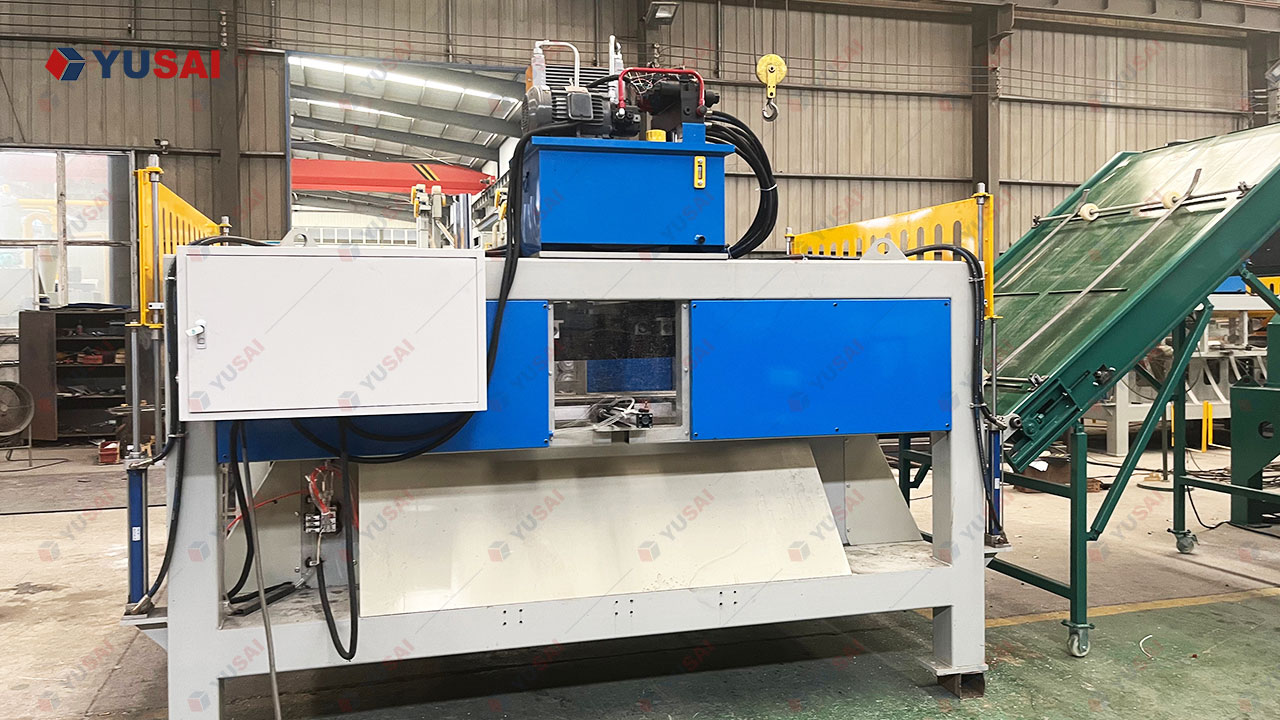
The solar panel aluminum frame removal machine is built on a heavy-duty welded steel frame and integrates the following main systems:
- Heavy-duty steel frame — a high-strength square-tube welded structure supporting all working assemblies, stable under continuous 24-hour operation
- Hydraulic power unit — an industrial pump station supplying stable, adjustable oil pressure to the pressing plate and pulling cylinders
- Pressing & stripping assembly — a vertical pressing plate that clamps the panel, plus front, rear, left and right pulling cylinders that break the corner joints and peel the four frame sides
- Work platform & positioning — a flat work table with frame grooves and guide rails that align panels of different sizes precisely
- Control system — PLC + touch screen (automatic model) or manual control lever (semi-automatic model), with emergency stop and optional sensor positioning
- Safety & collection devices — peripheral protective guard net, emergency stop, and integrated frame collection chute/bins
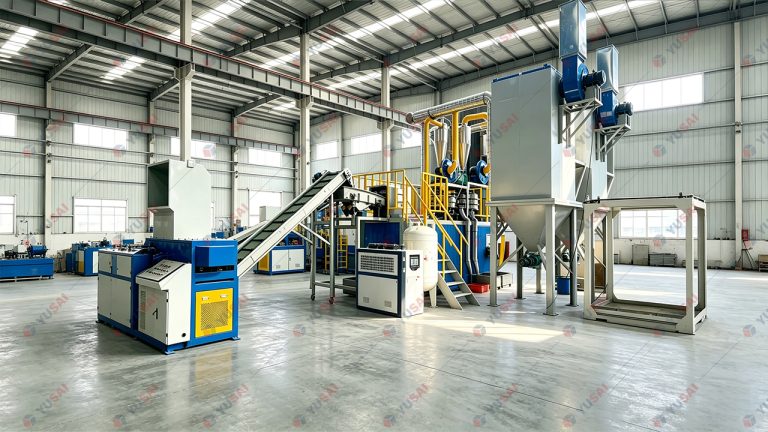
Optional add-ons: infeed/outfeed conveyor belts, CCD or limit-switch positioning, junction box removal station, and a dust extraction port for connection to a central dust collector. The machine’s modular design allows it to be combined with the glass removing machine, crusher, and sorting equipment to form a complete automated solar panel recycling plant.
Process Flow
Operating sequence (semi-automatic / automatic model):
- Loading — the operator (or conveyor) places the solar panel on the work platform, glass side up or back side up as configured.
- Positioning — guide rails and (optionally) sensors align the panel for a consistent cycle.
- Clamping — the hydraulic pressing plate descends and firmly clamps the panel surface, holding it immobile.
- Frame stripping (four sides) — the front and rear pulling rods extend first to break the corner joints and separate the two long-side frames; the left and right pulling rods then remove the remaining short-side frames. Hydraulic pressure is adjustable so the frame is peeled rather than crushed.
- Discharge — the pressing plate rises and all pulling rods retract; the operator removes the frame-free panel core for the next stage, while the aluminum frames fall into the collection bin below.
A complete cycle takes 10–30 seconds per panel (2–6 panels per minute depending on model and operator), with the automatic model reaching 60–120 panels per hour.
For double-glass (bifacial) modules, the panel core after frame removal enters a pyrolysis tunnel furnace instead of mechanical glass removal, which separates glass, silicon and copper ribbons through controlled thermal decomposition.
Product Features
- Non-destructive removal — The hydraulic pressing plate and four-sided pulling rods separate the frame by peeling force rather than impact, protecting the tempered glass and silicon cells. Low breakage rate means more recoverable material and higher downstream value.
- High processing efficiency — 10–30 seconds per panel; 40–120 panels per hour depending on model. A semi-automatic unit replaces 4–5 manual workers with one or two operators.
- Wide size compatibility — Adjustable positioning and pressing pressure accommodate panels from 750 × 1500 mm up to 1500 × 2550 mm, covering 60-cell, 72-cell, and large-format G1/M6/M10/M12 modules, as well as double-glass and bifacial types.
- Adjustable hydraulic force — Pressure and stroke settings adapt to different frame profiles and adhesive conditions, ensuring clean separation of the aluminum frame without crushing the panel core.
- Clean, high-purity output — The aluminum frame is removed whole, free of glass shards, EVA residue and polymer contamination, maximizing its resale price as clean alloy scrap.
- Enhanced safety design — Peripheral protective guard net, emergency stop button, and electrical interlock protect operators from moving parts and residual photovoltaic charge.
- Low labor cost — One-button / one-lever operation; the automatic model runs with minimal intervention under PLC control, reducing labor costs by 60% or more compared with manual dismantling.
- Modular line integration — Standardized interfaces allow seamless combination with junction box removing, glass removing, crushing, and sorting machines to build a complete turnkey solar panel recycling plant.
- Low maintenance — Industrial-grade hydraulic components and a robust welded frame support continuous 24-hour operation with minimal upkeep.
- Fully customizable — Voltage (380V / 415V / 480V, 50/60 Hz), capacity, model configuration, and auxiliary devices can all be tailored to your project.
Technical Parameters
Two series are available: YS-AFR-S (semi-automatic) for flexible, low-volume operations, and YS-AFR-A (fully automatic) for industrial-scale solar panel recycling plants.
YS-AFR-S Semi-Automatic Solar Panel Aluminum Frame Removing Machine
- Model: YS-AFR-S1600
- Operation mode: Semi-automatic (manual loading, hydraulic stripping)
- Processing capacity: 40–60 pcs/hour (10–15 s/panel)
- Applicable panel size: length 1500–2550 mm; width 750–1500 mm
- Driving system: Hydraulic (pump station + cylinders)
- Hydraulic cylinders: 5 pcs (1 pressing + 4 pulling)
- Motor power: 4 kW / 5.5 kW
- Voltage supply: 380V / 415V / 480V, 3-phase, 50/60 Hz (customizable)
- Control: Manual control lever / PLC optional
- Machine weight: Approx. 1,200 kg
- Dimensions (L×W×H): Approx. 2100 × 2150 × 2100 mm
YS-AFR-A Fully Automatic Solar Panel Aluminum Frame Removing Machine
- Model: YS-AFR-A2000
- Operation mode: Fully automatic (conveyor feeding + PLC control)
- Processing capacity: 60–120 pcs/hour (up to 2 pcs/min)
- Applicable panel size: length 1500–2500 mm; width 900–1400 mm
- Driving system: Hydraulic + pneumatic
- Frame removal method: Four-sided hydraulic pressing/stripping
- Motor power: 10 kW
- Voltage supply: 380V / 415V / 480V, 3-phase, 50/60 Hz (customizable)
- Control: PLC + touch screen (Siemens/Delta)
- Safety features: Peripheral protective net, emergency stop, electrical interlock
- Frame collection: Integrated collection bins/chutes
- Machine weight: Approx. 3,500–5,000 kg
- Dimensions (L×W×H): Approx. 3500 × 3500 × 2000 mm
Note: The parameters above are reference values based on industry-standard configurations. Final specifications follow your actual machine configuration and can be fully customized — please provide your panel type, target capacity, and site conditions for a tailored solution.
Advantages
Compared with manual frame removal:
- One machine replaces 4–5 workers; labor cost reduced by 60% or more
- Consistent, repeatable separation quality — no human error, no scratched frames, no broken glass
- Higher operator safety: no hand tools, no sharp aluminum edges, no heavy lifting
- Throughput 3–5× higher than manual dismantling at the same staffing level
Compared with shredding the whole panel:
- The aluminum frame is recovered as whole, clean profiles instead of contaminated mixed scrap — worth significantly more per tonne
- The panel core stays intact, so glass, silicon cells and metals can be recovered separately at high purity in downstream stages
- Lower energy consumption: no need to shred the hard aluminum frame along with glass
Why choose YuSai Machinery:
- Factory-direct manufacturer — one-stop machinery manufacturer integrating R&D, design, production, sales, installation and after-sales service, with decades of experience serving the e-waste, precious metal and PV recycling industries
- Complete-line capability — we supply the full solar panel recycling line (junction box removal, frame removal, glass removal, crushing, sorting, dust collection), so every stage is matched and guaranteed by one supplier
- Material testing before purchase — send your panels to our factory for a free test with video report
- CE & ISO quality system — certified manufacturing and pre-delivery full-load trial runs
- Global track record — equipment exported worldwide with on-site installation and training support
Service Process
From first inquiry to after-sales support, we provide a complete service flow:
- Inquiry — you tell us your raw material type, daily capacity target, site conditions and budget
- Consultation — our engineers recommend the right model (semi-auto / auto) and line configuration
- Material test — optional: send 2–3 sample panels to our factory for a free test report and video
- Solution & quotation — detailed quotation, layout drawing, and delivery plan
- Production — order confirmation → manufacturing (in-stock: 7–15 days; custom: 25–30 days)
- Pre-delivery inspection — full-load trial run with your materials; test video shared before shipping
- Shipping — standard export wooden-case packing; FOB / CIF / DDP terms available
- Installation & training — step-by-step video guidance, or on-site installation, commissioning and operator training by our engineers
- After-sales — lifetime technical support, spare parts supply, and remote assistance
Warranty & After-Sales Service
- 12-month warranty on the main machine against manufacturing defects (wear parts excluded)
- — free remote consultation via WhatsApp, email or video call
- Spare parts availability — genuine hydraulic, electrical and mechanical spares supplied at any time
- Fast response — technical queries answered within 24 hours on working days; emergency remote troubleshooting with video guidance
- On-site service — optional installation and commissioning service by our engineers (travel and accommodation at customer’s expense), available worldwide
- Upgrade support — when your business grows, we help you expand from a standalone frame removal machine to a complete solar panel recycling plant
Precautions for Operation & Maintenance
Safety:
- Residual photovoltaic charge — solar cells generate electricity when exposed to light. Store and process panels away from direct sunlight, keep connectors shorted or covered, and wear insulated gloves when handling panels.
- Never bypass the safety guard net or emergency stop; keep hands and tools clear of the pressing plate and pulling rods during the cycle.
- Use lifting aids or two-person handling for heavy panels to avoid back injury; wear cut-resistant gloves when handling damaged panels with sharp glass edges.
- Electrical installation and repair must be performed by a qualified electrician; ensure proper grounding and correct voltage supply.
Operation:
- Load panels within the machine’s size range; oversized or severely warped panels should not be forced into the work platform.
- For panels with severe cracks or shattered glass, use the semi-automatic model with reduced pressing pressure.
- Clean frame residue and glass dust from the work platform and collection bins at the end of each shift.
Maintenance:
- Check hydraulic oil level and quality monthly; replace per the maintenance schedule; watch for oil leakage and overheating.
- Inspect hydraulic hoses, cylinders and seals regularly; replace worn seals promptly.
- Grease moving parts and check bolt torque after the first week of operation, then periodically.
- Keep the PLC cabinet dry, dust-free and properly ventilated.
Frequently Asked Questions (FAQ)
Q1: What is a solar panel aluminum frame removing machine?
A solar panel aluminum frame removing machine (also called a PV panel de-framing machine or frame dismantling machine) is the first-stage pre-treatment equipment in a solar panel recycling plant. Using hydraulic force, it automatically separates the aluminum frame from end-of-life photovoltaic modules without damaging the tempered glass or solar cells, delivering clean aluminum scrap and an intact panel core for downstream recycling.
Q2: Can the machine handle broken or damaged solar panels?
For standard retired panels, the automatic model processes them perfectly. For panels with severe cracks or shattered glass, we recommend the semi-automatic model, where the operator controls the pressing force and stripping sequence to avoid further damage.
Q3: Does it work with double-glass and bifacial panels?
Yes — an extended model handles double-glass and bifacial modules up to 2550 mm in length. Because double-glass panels have no traditional backsheet, a pyrolysis treatment line is generally recommended for their downstream recycling stages.
Q4: What is the processing capacity?
The semi-automatic model processes 40–60 panels per hour; the fully automatic PLC-controlled model reaches 60–120 panels per hour, depending on panel size and operator efficiency. Each cycle takes about 10–30 seconds.
Q5: Can it be integrated into a complete solar panel recycling line?
Yes. With modular interfaces, it combines with our junction box removing machine, glass removing machine, crusher and electrostatic sorting equipment to form a complete automated solar panel recycling plant — all from one supplier.
Q6: Can I test my solar panels before buying?
Absolutely. Send 2–3 sample panels to our factory and we will run a free test, then provide the test report and working video before you place your order.
Q7: What is the delivery time?
In-stock machines ship within 7–15 days. Custom-configured machines are typically delivered in 25–30 days after order confirmation.
Q8: How many workers are needed?
Only 1–2 operators. The semi-automatic model needs one operator for loading; the automatic model runs with minimal intervention under PLC control.
Q9: What is the warranty and after-sales service?
Every machine includes a 12-month warranty on the main machine and lifetime technical support via WhatsApp, email or video call. Spare parts are always available, and on-site installation and operator training can be arranged.
Q10: How much does the machine cost?
The price depends on model, power and configuration. As a direct factory, we offer competitive factory-direct pricing — contact us with your capacity and panel type requirements for a detailed quotation.

Get A Free Quote
Fill in the form below and our service team will get back to you within 24 hours with a recommended process flow and quotation.
- +86 18339216321
- info@yusaipreciousmetals.com
- Zhengzhou.Henan.China
- Solar Panel Recycling Plant
- Solar Panel Pyrolysis Recycling Plant
- Solar Panel Junction Box Removing Machine
- Solar Panel Aluminum Frame Removing Machine
- Solar Panel Glass Removing Machine
- Solar Panel Pyrolysis Tunnel Furnace
- Solar Panel Pyrolysis Sorting System
- Solar Panel Crushing Sorting System
- Silver Stripping Machine
If you be interested in our equipment and solutions, please to contact us.
- +86 18339216321
- info@yusaipreciousmetals.com
- zhengzhou.henan.china