
Solar Panel Pyrolysis Sorting System
— Solar Panel Pyrolysis Sorting System
YuSai Solar Panel Pyrolysis Sorting System is a complete turnkey solar panel recycling plant that converts end-of-life, damaged and production-offcut photovoltaic (PV) modules into high-value raw materials. The line automatically removes junction boxes and aluminum frames, thermally decomposes EVA encapsulant and backsheet in an oxygen-free tunnel furnace at 400–600 °C, then crushes and sorts the residue to recover high-purity tempered glass, silicon cells, copper, aluminum and silver — with an overall material recovery rate of more than 95%. Built for capacities from 500 kg/h to 2000 kg/h, the plant meets international environmental emission standards and can be customized to your raw material, factory layout and local compliance requirements.
Product Overview
Solar panels have a design life of approximately 25–30 years. The first large-scale PV installations of the early 2000s are now reaching the end of their service life, and the global “retirement wave” of decommissioned PV modules is expected to accelerate sharply from around 2030. Industry studies (IRENA / IEA-PVPS) project that cumulative end-of-life PV module waste could reach tens of millions of tonnes by 2050. At the same time, more and more countries and regions — led by the EU (WEEE Directive), the United States and several Asian markets — are restricting solar panel landfilling and introducing mandatory collection and recycling obligations for PV producers and plant owners.
A waste PV module is not “trash”: it is a concentrated resource containing tempered glass (65–75%), an aluminum frame (5–10%), plastics and EVA (about 10%), silicon cells (3–5%), copper (about 1%) and trace silver. Recycling the panel keeps hazardous materials such as lead and fluoropolymer backsheets out of landfills, while returning valuable materials to the manufacturing supply chain.
YuSai’s Solar Panel Pyrolysis Sorting System combines two proven technologies in one integrated line:
- Thermal pyrolysis — decomposes EVA (ethylene-vinyl acetate) encapsulant and polymer backsheets in an oxygen-free atmosphere, so glass and silicon cells are released intact instead of being shattered or contaminated.
- Mechanical crushing & sorting — reduces and separates the remaining material into marketable silicon powder, copper, mixed metals and plastics with airflow, vibration and electrostatic separation.
The result is a profitable, compliant and fully automated recycling plant for PV panel recyclers, photovoltaic power plant owners, module manufacturers, EPC companies and new-energy industrial zones.
Recycling Value Analysis
1. What a Waste Solar Panel Is Made Of
A waste crystalline silicon module is made up of the following materials (typical shares by weight, plus the recovered product and its downstream market):
- Tempered glass — 65–75% of module weight — recovered as clean glass cullet or whole sheets — sold to new glass product and glass manufacturing markets.
- Aluminum frame — 5–10% — recovered as clean aluminum scrap — used in construction, automotive and remelting industries.
- Plastics / EVA / backsheet — about 10% — recovered as a plastic fraction together with pyrolysis oil/gas — turned into new plastic products or used as fuel.
- Silicon cells — 3–5% — recovered as silicon powder or wafers — refined for new battery wafers and semiconductor materials after purification.
- Copper (busbars, wires, ribbons) — about 1% — recovered as copper powder or strips — recycled into electronics and remelting.
- Silver (paste on the cell surface) — 0.03–0.1%, approx. 6–20 g per standard module — recovered as silver concentrate, optionally refined to >99% purity — sold to the precious metal market.
Composition ranges depend on module type, generation and manufacturer. YuSai offers free raw-material testing before quotation so the recovery plan and expected outputs are confirmed with your actual panels.
2. Why the Business Case Works
- High recovery rate: the line recovers more than 95% of the panel by weight — far above typical landfill or low-value shredding routes.
- High-purity outputs: intact glass and whole delaminated silicon cells command premium prices; silicon wafer recovery can exceed 95% and glass integrity retention can exceed 90% under proper process control.
- Precious metal upside: the silver paste on the silicon cells is captured into a concentrated fraction, and can optionally be refined to more than 99% purity using YuSai’s in-house precious-metal refining technology — a valuable revenue stream that most mechanical-only lines lose.
- Multiple revenue streams: recyclers sell aluminum frames, glass, silicon powder, copper and plastics to different buyers, which diversifies income and stabilizes cash flow.
- Compliance-driven demand: WEEE-style legislation, landfill bans and corporate ESG/carbon-reduction targets are pushing PV waste toward certified recyclers, making licensed recycling capacity scarce and well-paid.
- Energy self-efficiency: the combustible syngas produced during pyrolysis of the EVA/backsheet is recycled to heat the furnace, saving up to 30% of fuel cost in continuous operation.
Applicable Materials (Raw Materials)
The YuSai Solar Panel Pyrolysis Sorting System is designed to process:
- Monocrystalline silicon PV panels (mono c-Si), including PERC, BSF, TOPCon and half-cut cell modules;
- Polycrystalline silicon PV panels (poly c-Si);
- Single-glass and double-glass (bifacial) modules;
- Damaged / end-of-life panels — hail damage, cracked glass, partial delamination, failed junction boxes;
- Production scrap and offcuts from photovoltaic module factories;
- Retired panels from power plants, roof-top systems and solar farms;
- Framed or frameless laminates (frame removal module available for whole-panel feeding).
Thin-film (CdTe, CIGS) modules follow a different chemistry and process route — please contact us with your panel type and photos for a dedicated solution.
Product Structure (Main Equipment)
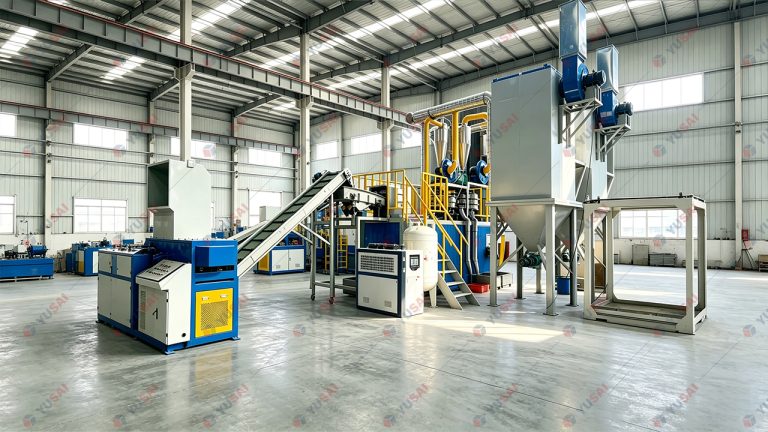
The system is delivered as a complete integrated production line. Main equipment modules include:
- Automatic feeding & conveying system — buffered, uniform feeding of whole or pre-treated panels; belt conveyors transfer material between stages.
- Junction box removing machine — cuts and removes junction boxes, recovering copper-rich connectors and plastics.
- Aluminum frame removing machine (frame puller) — automatically separates the aluminum frame in one piece — clean, directly sellable scrap.
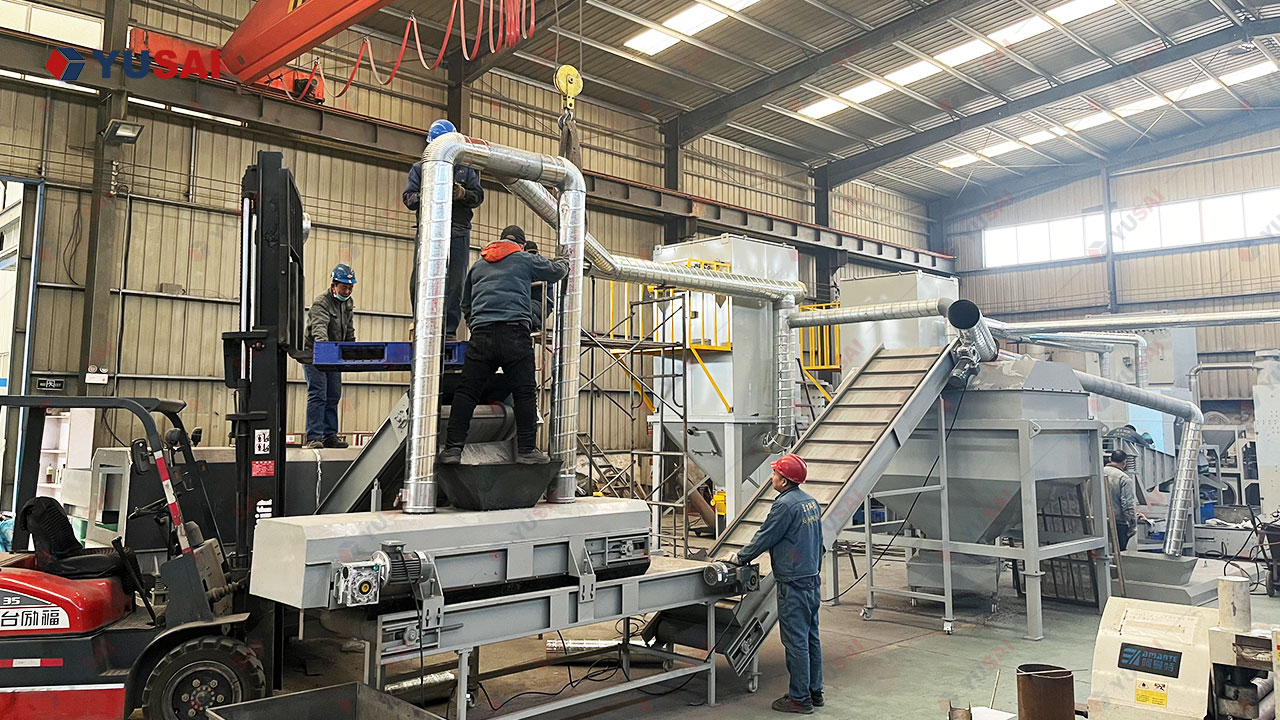
- Continuous pyrolysis tunnel furnace — oxygen-free thermal treatment at 400–600 °C; decomposes EVA encapsulant and polymer backsheet while keeping glass and silicon cells intact.
- Syngas condensation & energy recovery system — converts part of the pyrolysis gas into pyrolysis oil and recycles combustible gas to heat the furnace (up to 30% fuel saving).
- Exhaust gas purification system — multi-stage treatment: secondary combustion chamber → cooling tower → wet scrubber → activated carbon adsorption → catalytic oxidation; meets strictest global emission standards.
- Double-shaft shredder — shreds released laminates into ~50 mm × 10–20 mm strips.
- Blade cutting crusher — further reduces material to 1–1.5 cm pieces.
- Grinding mill — grinds crushed material into 15–20 mesh uniform powder for efficient separation.
- Airflow & vibration separator — airflow + vibration classification to separate copper and heavy metals from plastics.
- Electrostatic separator — high-voltage electrostatic separation to recover residual metals from non-metallic powder, raising total metal recovery.
- Magnetic separator (optional) — removes ferrous contaminants.
- Optical sorter (optional) — color/optical separation of glass, silicon and metals for highest output purity.
- Pulse dust collector — captures dust generated during crushing and sorting; prevents secondary pollution.
- PLC control cabinet & monitoring system — centralized control, uniform feeding, coordinated operation, real-time temperature and process monitoring.
- Silver extraction system (optional) — hydrometallurgical / electrolytic recovery of silver paste from silicon cells — can be integrated with YuSai’s precious-metal refining line.
All modules are factory-tested before delivery and can be configured according to your capacity and budget (batch or continuous mode, different levels of automation).
Process Flow
The complete recycling workflow is a closed, continuous process:
- Incoming inspection & feeding — panels are inspected, stacked and fed automatically into the line.
- Pre-treatment dismantling — the junction box removing machine separates junction boxes; the aluminum frame removing machine pulls the aluminum frame off in one clean piece.
- Thermal pyrolysis (core process) — frameless panels enter the continuous pyrolysis tunnel furnace. In an oxygen-free atmosphere at 400–600 °C, the EVA encapsulant and polymer backsheet thermally decompose into combustible gas and oil, while tempered glass and silicon cells are released intact.
- Pyrolysis Sorting System — after thermal decomposition, the material moves into the integrated sorting system: glass is separated and collected as clean, high-purity cullet, while the remaining silicon/metal/plastic mass is shredded (~50 mm strips), crushed (1–1.5 cm pieces), ground to 15–20 mesh powder and sorted by airflow/vibration and electrostatic separation into silicon powder, copper, mixed metals and plastics. Dust is captured throughout by the pulse dust collector.
- Silver stripping — the silicon cells are processed through silver stripping to remove the silver paste from the cell surface, recovering silver that can be refined up to 99.99% purity — the highest-value fraction of the module — while the cleaned silicon is ready for separate sale or upgrading.

Product Features
- Highest-purity recovery: glass is kept intact (not crushed into powder) and silicon cells are delaminated whole — outputs that mechanical-only lines cannot achieve. Silicon wafer recovery >95%, glass integrity >90%.
- Energy efficient: the combustible syngas from EVA/backsheet pyrolysis is recycled to heat the furnace, saving up to 30% in fuel costs.
- Environmentally clean: no acid or alkali involved; multi-stage flue gas treatment (secondary combustion, cooling, wet scrubbing, adsorption, catalytic oxidation) plus pulse dust collection keeps emissions and dust within the strictest international standards — no secondary pollution.
- Fully automated: PLC control of the entire line ensures uniform feeding and coordinated operation; real-time temperature control and monitoring for safe, stable 24/7 production.
- Low labor cost: one line requires only a small team of operators, reducing manpower and operating cost.
- Custom capacity: standard designs from 500 kg/h to 2000 kg/h, extendable and configurable (batch or continuous, single- or double-glass, with/without silver extraction).
- Stable & durable: compact, rational structure, low noise, low failure rate and low long-term maintenance cost.
- Proven turnkey: design, manufacturing, installation, commissioning and operator training — all in one package from a manufacturer with OEM/ODM experience since 1995.
Technical Parameters
| Model (reference) | YS-SP-500 | YS-SP-1000 |
|---|---|---|
| Capacity | 500 kg/h | 1000 kg/h |
| Installed power | ~250 kW | ~350 kW |
| Floor area (L×W×H, approx.) | 25 × 8 × 6 m | 30 × 8 × 6 m |
| Pyrolysis temperature | 400–600 °C | 400–600 °C |
| Overall recovery rate | >95% | >95% |
| Silicon wafer recovery | >95% | >95% |
| Glass integrity | >90% | >90% |
| Operation mode | Continuous | Continuous |
| Control system | PLC + HMI | PLC + HMI |
| Fuel saving (syngas recycling) | Up to 30% | Up to 30% |
Note: the figures above are indicative reference values for standard configurations. Final capacity, power, footprint, recovery and purity are confirmed after raw-material testing and site review — every YuSai line is engineered to the customer’s actual material and layout.
Advantages (Why Choose YuSai Machinery)
- OEM/ODM manufacturer since 1995 — 20+ years of R&D and manufacturing experience in solid-waste recycling and precious-metal refining equipment, serving customers in 60+ countries and regions.
- Own factory & real engineering team — strong equipment production and process R&D capability; every machine is factory-tested before shipment.
- Turnkey project capability — from raw-material testing, solution and layout design, to manufacturing, delivery, installation, commissioning and operator training, one team handles everything.
- Free raw-material testing — send us your waste panels (or photos/specs) and we confirm the process route, expected outputs and recovery before you invest.
- Free layout & process design — we engineer the line to fit your factory footprint, capacity target and budget.
- Synergy with precious-metal refining — as a precious-metal refining equipment specialist (silver/gold electrolysis, refining lines), YuSai can integrate silver recovery from solar cells into one combined plant, unlocking the highest-value fraction that ordinary recycling lines lose.
- Compliance-first engineering — emission, dust and safety designs are built to international standards, simplifying your environmental permit process.
- 24-hour consultation response — a professional reply with a preliminary solution within 24 hours of your inquiry.
Service Process
- Consultation — tell us your raw material type, daily tonnage, target outputs and location; we reply with a preliminary solution within 24 hours.
- Raw-material testing — send samples or panel specs; we run process tests and confirm the recovery plan and expected product purity.
- Solution & layout design — free process design and factory layout drawing matched to your footprint.
- Quotation & contract — transparent quotation (equipment list, scope of supply, terms) and contract confirmation.
- Production — manufacturing with progress updates and quality inspections at each stage.
- Inspection & shipping — trial run before packing; export packing; shipment by FOB / CIF / DDP as agreed.
- Installation & commissioning — our engineers install and commission the line on site (or remote guidance, depending on scope).
- Operator training — full training on operation, maintenance and safety for your team.
- After-sales support — warranty, spare parts supply and lifetime technical support.
Warranty & After-Sales
- 12-month warranty on main equipment from the date of commissioning (wear parts excluded; details in the contract).
- Lifetime technical support — free consultation on operation and process issues for the life of the machine.
- Spare parts supply — genuine spare parts available for quick dispatch worldwide.
- Fast response — remote diagnosis within 24 hours; engineers available for on-site service when required.
- Documentation — operation manual, maintenance schedule, wiring diagrams and drawings provided with the line.
- Upgrade support — as regulations and markets evolve, we help you upgrade (e.g. add optical sorting or silver extraction) to protect your investment.
Precautions & Notes
- Feedstock control: remove junction boxes and aluminum frames wherever possible (our pre-treatment module does this automatically); keep foreign objects (concrete, metal rods, stones) out of the feed.
- Moisture: avoid feeding wet or rain-soaked panels in large batches; excessive moisture reduces pyrolysis efficiency.
- Fire & gas safety: the pyrolysis section is oxygen-controlled; operate strictly within the specified temperature range and keep the gas purification/condensation system maintained to prevent overpressure or leaks.
- Ventilation & emissions: ensure the site has the required environmental permits; the exhaust gas purification system must not be bypassed.
- Operator protection: provide PPE (gloves, safety glasses, respirators where needed); only trained operators may run the line.
- Maintenance: follow the maintenance schedule — lubrication, bearing checks, blade inspection, dust collector filter cleaning; record daily operation parameters.
- Local compliance: confirm your country’s import, installation and emission requirements before purchasing; we help document compliance needs during project design.
- Certified end-of-life handling: where required by law (e.g. WEEE), ensure your plant holds the appropriate recycling/waste-treatment license.
FAQ (Frequently Asked Questions)
Q1. What capacity of solar panel recycling plant do I need?
A: Standard designs cover 500–2000 kg/h. Tell us your planned tons-per-day (e.g. 10 t/day at 2 shifts) and we will size the line accordingly. Larger custom capacities are also possible.
Q2. Which types of solar panels can this plant process?
A: It is designed mainly for crystalline silicon modules — monocrystalline and polycrystalline, including PERC, BSF, TOPCon, single-glass and double-glass (bifacial) panels — as well as damaged, hail-hit and delaminated panels. Thin-film (CdTe/CIGS) modules need a different route — please consult us.
Q3. What is the actual recovery rate?
A: Under proper process control, overall material recovery exceeds 95% of the panel weight, silicon wafer recovery can exceed 95%, and glass integrity retention exceeds 90%. Exact figures are confirmed by raw-material testing for your specific panels.
Q4. What products come out, and who buys them?
A: Aluminum frames (scrap metal market), clean glass (glass manufacturers), silicon powder (semiconductor/new-cell makers after purification), copper (electronics/remelting), plastics (plastic industry) and — optionally — silver concentrate/refined silver. Buyers include local scrap traders, glass factories, foundries and precious-metal refiners.
Q5. Is the process environmentally compliant?
A: Yes. Pyrolysis runs oxygen-free with no acid or alkali; the multi-stage exhaust gas purification system (secondary combustion, cooling, wet scrubbing, adsorption, catalytic oxidation) and pulse dust collection are engineered to meet the strictest international emission standards.
Q6. Does pyrolysis destroy the silicon cells?
A: No — that is the key advantage of pyrolysis over mechanical-only recycling. At 400–600 °C in an oxygen-free atmosphere, the EVA/backsheet decomposes while silicon cells and glass are released intact, which is why silicon wafer recovery can exceed 95%.
Q7. How long does installation and commissioning take?
A: Typically 2–4 weeks on site depending on line size and site readiness; our engineers handle installation, commissioning and operator training (or remote guidance, depending on scope).
Q8. Do you provide the silver extraction option?
A: Yes. As a precious-metal refining equipment manufacturer, we can integrate a silver extraction/refining module so you recover silver from the cell paste at more than 99% purity — turning the highest-value fraction of the panel into an extra revenue stream.

Get A Free Quote
Fill in the form below and our service team will get back to you within 24 hours with a recommended process flow and quotation.
- +86 18339216321
- info@yusaipreciousmetals.com
- Zhengzhou.Henan.China
- Solar Panel Recycling Plant
- Solar Panel Pyrolysis Recycling Plant
- Solar Panel Junction Box Removing Machine
- Solar Panel Aluminum Frame Removing Machine
- Solar Panel Glass Removing Machine
- Solar Panel Pyrolysis Tunnel Furnace
- Solar Panel Pyrolysis Sorting System
- Solar Panel Crushing Sorting System
- Silver Stripping Machine
If you be interested in our equipment and solutions, please to contact us.
- +86 18339216321
- info@yusaipreciousmetals.com
- zhengzhou.henan.china