The fast‑growing deployment of photovoltaic installations worldwide creates a rising volume of end‑of‑life PV modules. Waste crystalline‑silicon solar panels contain recoverable silicon, precious and base metals, turning retired solar hardware into an urban‑mining resource. Many investors and recycling operators want clear mass figures: exactly how much silicon and metal can be obtained by dismantling and processing one used PV panel?
This article focuses on mainstream crystalline‑silicon modules, covering theoretical material content, real‑world industrial recovery yields, and performance differences between old‑generation PERC and modern N‑type panels.
Material Content of Typical Waste PV Modules
Two widely‑seen module formats are referenced below: standard 60‑cell modules (~20 kg, 270‑330 W) and large‑size 72‑cell modules (~26‑28 kg, 400 W+). All values below represent original material mass inside the panel before recycling, not final purified output.
60‑cell PV module (20 kg, PERC technology)
- Silicon: 0.6‑0.8 kg (3‑4 % of total module weight)
- Aluminium (frame): 2.0‑2.8 kg
- Copper (ribbons & junction box): 0.10‑0.18 kg
- Silver (front‑side metallization paste): 8‑15 g
- Tin plus trace lead: 5‑12 g
Large‑size 72‑cell PV module (26‑28 kg, PERC technology)
- Silicon: 0.9‑1.1 kg
- Aluminium (frame): 2.8‑3.5 kg
- Copper: 0.15‑0.22 kg
- Silver: 12‑20 g
Note for N‑type TOPCon / HJT panels: silver consumption drops sharply. Some adopt copper‑plated gate lines, bringing silver content down to merely 3‑6 g per panel. Recycling project calculations cannot reuse PERC‑based silver data for N‑type waste modules.
Reference per tonne of waste PV panels
Per 1 tonne of end‑of‑life crystalline‑silicon PV modules:
- Silicon: 30‑40 kg
- Aluminium: 100‑150 kg
- Copper: 5‑10 kg
- Silver: 0.3‑0.6 kg
- Tin: 0.5‑1 kg
Industrial‑Scale Recovery Rate (Not 100 % Yield)
The theoretical material weight inside panels cannot equal final recovered product weight. Actual output depends on pretreatment, mechanical dismantling, hydrometallurgical separation and electrolytic refining equipment.
- Aluminium: Easy physical frame removal. Industrial recovery rate reaches 95 % and above, one of the most straightforward‑to‑recycle fractions.
- Copper: Extracted from interconnection ribbons and junction‑box wiring. Typical industrial recovery: 80 %‑90 %.
- Silver: Recovered mainly by hydrometallurgical leaching followed by electrolytic refining. Stable industrial lines achieve 75 %‑88 % silver recovery. Silver is the highest‑value trace metal inside old PV panels.
- Silicon: The most technically challenging target. Silicon wafers are tightly mixed with EVA polymer, silicon‑nitride anti‑reflection layers and aluminium back‑surface field layers after crushing. Simple mechanical sorting only delivers mixed silicon powder with heavy impurities. Well‑designed industrial workflows can hit 60 %‑80 % recovery for solar‑grade silicon. Many small‑scale recyclers skip silicon recovery entirely and only harvest aluminium, copper and silver.
Process Route Choices for PV‑Panel Recycling
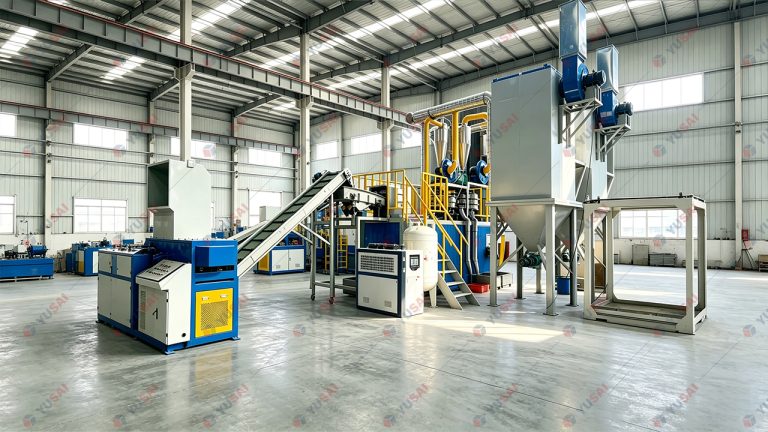
Complete waste PV recycling normally combines mechanical pretreatment with hydrometallurgical purification and electrolytic refining units:
- Mechanical dismantling: separate aluminium frames, junction boxes and glass; crush and delaminate cell fragments from EVA encapsulant.
- Hydrometallurgical leaching system: dissolve silver, copper and other metallic fractions from crushed cell material for element enrichment and separation.
- Electrolytic refining equipment: produce high‑purity silver, copper and other target metals that satisfy semiconductor and advanced‑material requirements.
- Auxiliary environmental equipment: waste‑gas treatment systems handle acid‑process exhaust such as NOₓ, to keep operations fully compliant with emission standards.
Small‑batch lab‑scale electrolysis test units are available for process formulation verification before investors commit to full‑size turn‑key production lines.
Conclusion
Waste photovoltaic panels hold tangible circular‑economy value, yet material recovery is constrained by panel generation (PERC vs N‑type), pretreatment quality and metallurgical‑process maturity. When evaluating recycling‑project profitability, operators should not only look at theoretical metal‑content figures, but also take practical industrial recovery ratios into consideration.
Complete sets of solid‑waste recycling production lines, integrating mechanical pretreatment, hydrometallurgical separation and electrolytic refining, are essential to unlock full resource potential from end‑of‑life PV modules while meeting environmental‑protection compliance requirements.