
Solar Panel Crushing Sorting System
— Solar Panel Crushing Sorting System
The Solar Panel Crushing Sorting System is a fully automated, turnkey PV module recycling line engineered to process end-of-life, damaged or decommissioned crystalline silicon (c-Si) solar panels — covering monocrystalline, polycrystalline and bifacial modules. Operating through a purely physical dry process of multi-stage shredding, fine crushing, grinding, sieving, airflow classification and high-voltage electrostatic separation, the system converts panel waste into clean, directly saleable raw materials: aluminum frame scrap, glass cullet, copper powder, plastic (EVA/backsheet) powder and silicon powder — with the silicon-silver fraction further refinable downstream into silver of 99.99% purity.no chemicals, no water, no secondary pollution.
Product Overview
Global solar capacity has grown exponentially over the past two decades, and the first large wave of installations from the early 2000s is now reaching its 25–30 year end-of-life. Millions of metric tons of decommissioned photovoltaic (PV) modules will require responsible processing in the coming decade, and landfilling is no longer a sustainable or compliant option. A typical crystalline silicon (c-Si) panel contains 60–80% glass, 10–15% aluminum, 3–10% silicon, around 1% copper and trace silver — all of which carry real market value when properly recovered.
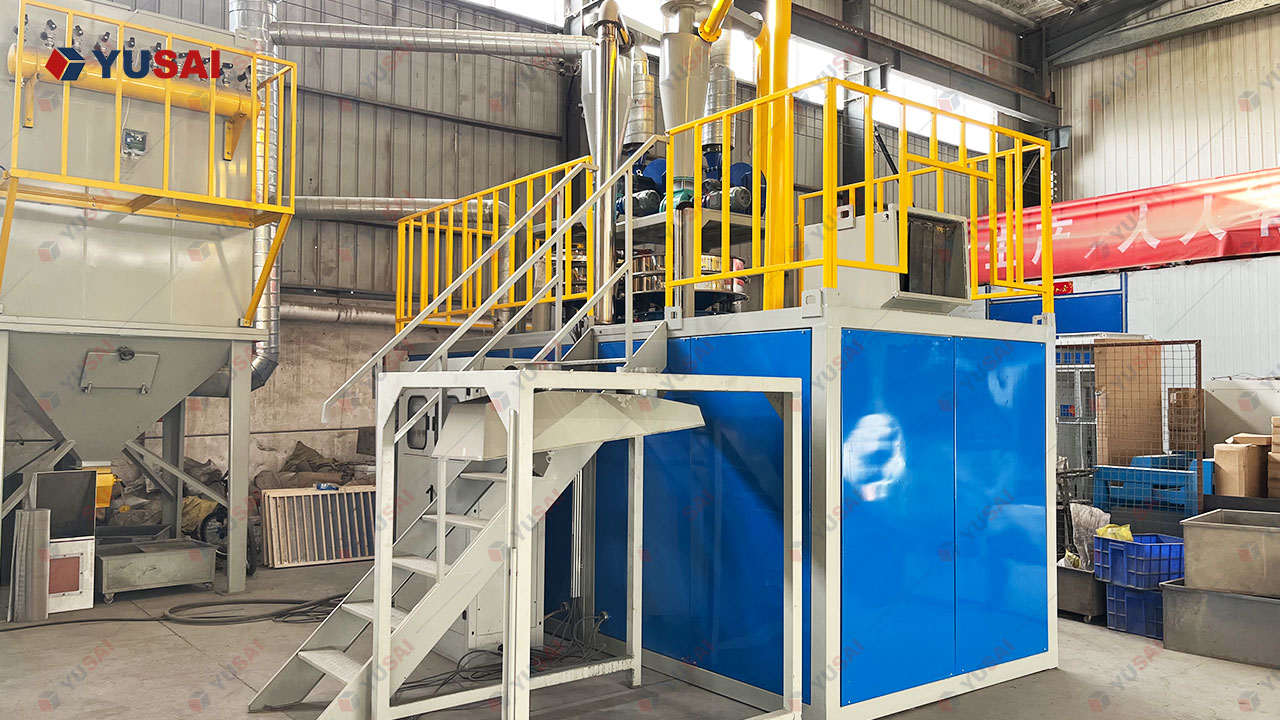
The YuSai Machinery Solar Panel Crushing Sorting System is a complete turnkey solution engineered for commercial-scale PV waste processing. Designed for crystalline silicon modules — including monocrystalline, polycrystalline and bifacial types — the line integrates feeding, shredding, fine crushing, multi-stage sieving, airflow classification and electrostatic separation into one compact, PLC-controlled production train. Outputs are clean, saleable fractions: aluminum scrap, glass cullet, copper powder, plastic (EVA/backsheet) powder and silicon powder, which can be further processed downstream for silver recovery.
Every YuSai system is built around four principles: maximum material recovery, high output purity, zero chemical use, and low operating cost — giving recyclers, solar farm operators and e-waste processors a fast and measurable return on investment.
Recycling Value Analysis
Recycling solar panels is not only an environmental obligation — it is a documented economic opportunity.
A typical crystalline silicon module is composed of: tempered glass (60–80%), an aluminum frame (10–15%), silicon cells (3–10%), EVA encapsulant (5–8%), backsheet of TPT/PVDF (about 5%), junction box and wiring (2–3%), copper solder strips and cables (about 1%), and silver conductive paste (below 0.1% by weight but exceptionally high in value).
Why the recovered value is real:
- Glass — the largest fraction by weight — is cleaned and processed into cullet for glass manufacturing, construction materials and insulation; high-transparency PV glass can be reprocessed into channel glass for building-integrated photovoltaics.
- Aluminum frames are removed intact and sold directly to smelters; recycling aluminum saves up to 95% of the energy required for primary production.
- Copper from solder strips, cables and junction boxes is recovered as high-grade scrap, a staple commodity on global metal markets.
- Silicon is concentrated into silicon powder for reuse in new PV cells, semiconductor applications or as a heat-dissipation material.
- Silver, although present at under 0.1%, delivers the highest value per gram in the entire module. A typical 1 MW solar farm contains roughly 20–30 kg of silver in its modules. Through our downstream refining route — acid leaching followed by electrolytic refining — silver can be recovered at 99.99% purity, turning the smallest fraction into one of the most profitable output streams of the plant.
Market context: Macquarie University estimates the economic value of materials contained in 800,000 tons of PV waste at approximately US$1.25 billion. With the first global retirement wave of solar panels projected to peak in the 2030s, building processing capacity today is a strategic decision for recyclers, solar asset owners and governments alike.
Applicable Materials
The system processes the most common PV module types on the market:
- Monocrystalline silicon (c-Si) panels — the mainstream module type. Fully supported.
- Polycrystalline silicon (c-Si) panels — the mainstream module type. Fully supported.
- Bifacial / double-glass panels — supported with the dedicated glass separation module or tunnel pyrolysis pre-treatment.
- Damaged, defective and end-of-life modules — the standard input for this line.
- Deframed, de-boxed panels — the recommended feed after frame removal and glass removal machines; also accepts complete modules when configured with upstream dismantling units.
- Thin-film modules (CdTe / CIGS) — available on request; process design confirmed with material samples first.
Feed specification: standard crystalline panel formats of approximately 1000–2400 mm in length and 800–1300 mm in width; dry feed with moisture kept at or below 5% for stable separation performance.
System Structure & Main Equipment
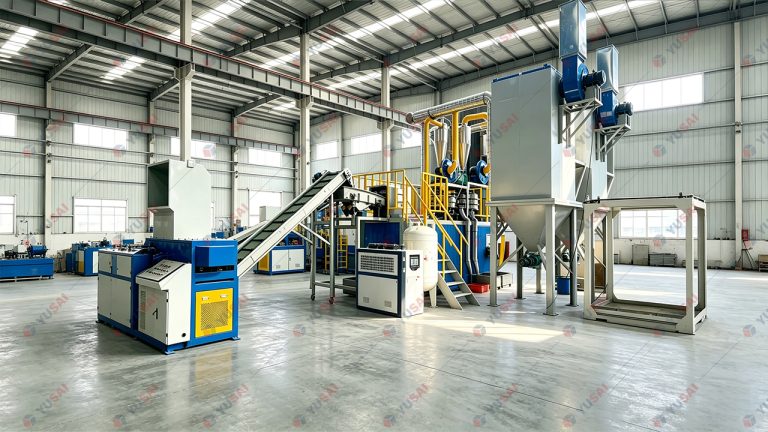
A complete solar panel crushing sorting system is built from the following modular units, arranged in a continuous production train:
Panel Feeding & Frame Removal Machine — hydraulic disassembly removes and collects the aluminum frame automatically at a removal rate of 99%+, without damaging the glass or cells. Adapts to different panel sizes and models.
Glass Removal Machine — specialized delamination unit separates the tempered glass layer from the EVA laminate and cell layer. Achieves 85–95% glass removal with 90%+ purity. Bifacial and double-glass modules are routed to the dedicated glass module or tunnel pyrolysis pre-treatment.
Primary Shredder & Crusher — the deframed, de-glassed laminate is shredded into small pieces, then crushed to break apart the EVA film, silicon wafers and solder strips, liberating the valuable fractions for downstream separation.
Grinding & Multi-Stage Sieving System — fine grinding reduces the material to powder grade; vibrating and circular vibrating screens classify particle sizes and extract a first cut of silicon powder.
Airflow / Gravity Classifier — airflow classification separates the light plastic (EVA/backsheet) powder from the heavier metal and silicon fractions; gravity separation refines the split.
High-Voltage Electrostatic Separator — the core separation technology of the line. Conductive metals (copper and silver-bearing particles) are isolated from non-conductive silicon powder and plastics under a high-voltage electrostatic field, with sorting efficiency of 95–99%.
Pulse-Jet Baghouse Dust Collection System — a closed, negative-pressure pipeline connects every dust point to a high-efficiency pulse-jet bag filter with 99% collection efficiency, keeping the workshop clean and compliant with air emission standards — no dust leakage, no secondary pollution.
Centralized PLC Control System — Siemens/Schneider PLC with touchscreen HMI enables single-operator monitoring of feeding, conveying, sorting and dust collection, with fault alarms and data logging. Remote monitoring available on request.
Solar Panel Crushing Sorting System Process Flow
The process is a 100% physical, water-free and chemical-free dry route:
- Frame removal — end-of-life panels are fed onto the conveyor; the frame removal machine detaches the aluminum frame automatically (99%+ recovery).
- Glass separation — the tempered glass layer is separated from the EVA laminate and cell layer (85–95% removal).
- Shredding & crushing — the remaining laminate is shredded into pieces and crushed to liberate silicon wafers, EVA and solder strips.
- Fine grinding — material is ground to powder grade.
- Multi-stage sieving — vibrating screens classify particles and extract a first portion of silicon powder.
- Airflow & gravity classification — plastic powder is separated from metals and silicon.
- Electrostatic separation — copper and silver-bearing particles are isolated from silicon powder and plastics; output purity reaches 95%+ for copper and 90%+ for glass and plastic fractions.
- Dust collection — every stage operates under closed negative pressure, with the pulse-jet baghouse capturing fines at 99% efficiency.
Output streams: aluminum frame scrap, glass cullet, copper powder, plastic powder and silicon powder (with an average silicon content of about 45%, further upgradable).
Optional downstream stage — precious metal refining: the silicon-silver fraction can be processed in our hydrometallurgical refining line (acid leaching → filtration → precipitation → reduction → electrolytic refining → casting) to produce 99.99% pure silver ingots. This upgrades the lowest-value residue into the highest-margin output of the plant.

Product Features
- High separation efficiency — frame removal 99%+, glass removal 85–95%, metal separation 95%+, overall material recovery up to 98%+.
- High output purity — copper 95%+, glass 90%+, plastic 90%+; recovered materials meet the purity levels buyers expect and command better resale prices.
- Water-free and chemical-free process — purely physical dry-type recycling; zero chemical consumption, zero wastewater, no combustion in the standard route. Fully aligned with modern environmental requirements.
- PLC automation — centralized touchscreen control reduces labor cost and human error; one operator can manage the entire line.
- Closed-loop negative-pressure dust control — pulse-jet baghouse with 99% collection efficiency; no dust leakage; compliant with GB16297-1996 and configurable to EU or local emission standards.
- Compact and stable design — modular layout, stable performance, low noise, low failure rate and low maintenance cost.
- Wide material adaptability — handles monocrystalline, polycrystalline and bifacial modules, with capacity and layout customized to the customer’s tonnage and site.
- Turnkey project delivery — from layout design, delivery and installation to commissioning, operator training and spare parts support.
Technical Parameters
Material recovery performance:
| Output Material | Recovery Rate | Output Purity |
|---|---|---|
| Aluminum frame | 99%+ | 98%+ |
| Glass | 85–95% | 90%+ |
| Copper | 95%+ | 95%+ |
| Plastic (EVA/backsheet) powder | 95%+ | 90%+ |
| Silicon powder | ~95% | silicon content ~45% (upgradable) |
| Silver (via downstream refining) | 95%+ | 99.99% |
Material recovery performance:
| Parameter | Specification |
|---|---|
| Applicable panels | Mono / poly / bifacial c-Si modules; panel length ~1000–2400 mm, width ~800–1300 mm |
| Separation technology | Crushing + sieving + airflow/gravity classification + high-voltage electrostatic separation |
| Control system | Siemens/Schneider PLC with touchscreen HMI |
| Dust collection | Pulse-jet baghouse, 99% collection efficiency, negative-pressure pipeline |
| Working voltage | Customizable (e.g., 380 V / 415 V / 440 V / 480 V, 50 Hz or 60 Hz) |
| Process type | 100% physical dry route — water-free, chemical-free |
Detailed model-specific parameters (capacity, power consumption, footprint) are provided with the project proposal according to your required daily tonnage.
Advantages (Why Choose YuSai Machinery)
- Factory-direct manufacturer. YuSai Machinery designs, manufactures and factory-tests every system in our own facility in Henan, China — direct factory pricing, full quality control and reliable delivery schedules.
- Precision engineering heritage. As a precision machinery company, we apply the same rigorous fabrication, welding and assembly standards used in our precious metal refining equipment to every recycling line we build.
- Proven export track record. Our e-waste recycling and precious metal refining equipment is installed across Asia, Africa, Europe and Latin America, with engineers available for on-site installation, commissioning and training.
- Customized solutions. Capacity, working voltage, layout and downstream refining modules are configured to your raw material, space and budget. Every project starts with a free process design.
- Complete documentation package. Process flow diagrams, foundation drawings, floor plans, operation manuals and spare parts lists are delivered with every order.
- Rapid return on investment. High recovery rates and pure outputs translate directly into revenue — aluminum, glass and copper are monetized from day one, while silicon and silver add margin as refining capability grows.
- One-stop resource recovery partner. From solar panel crushing and sorting to silver/gold electrolytic refining and e-waste PCB recycling, YuSai covers the full value chain — one supplier, one warranty, one point of contact.
Service Process
- Inquiry & consultation — you share your raw material, daily volume and site conditions; we reply with a process design proposal within 24 hours.
- Quotation & negotiation — itemized quotation, layout drawing and delivery terms (FOB / CIF / DDP) within 1–3 days.
- Order confirmation — contract, payment terms and production schedule confirmed.
- Manufacturing — production with in-process photo and video updates to the client; typical lead time 30–45 days.
- Factory acceptance test — trial run and video verification before shipment.
- Shipping & logistics — export-standard waterproof and vibration-proof packing, complete customs documentation.
- Installation & commissioning — our engineers support on-site installation and commissioning (typically 7–15 days on site) or provide detailed remote guidance.
- Operator training — hands-on training for operators and maintenance staff, supported by complete manuals.
- After-sales support — remote troubleshooting, factory-price spare parts and lifetime technical support.
Warranty & After-Sales Service
- Standard warranty: 12 months from the date of commissioning, covering manufacturing defects of mechanical and electrical parts (excluding consumables and misuse damage).
- Extendable warranty: optional extended plans are available for multi-year coverage.
- Spare parts: a recommended wear-parts list (screens, hammers, blades, filter bags, etc.) is provided with the order; spare parts are supplied at factory prices with fast global dispatch.
- Technical support: lifetime free consultation via WhatsApp, email or video call; remote diagnostics and PLC program support included.
- On-site service: experienced engineers can be dispatched for commissioning, maintenance and operator training; long-term service contracts available.
- Documentation: operation manual, maintenance manual, electrical drawings and spare parts catalog are delivered in both paper and electronic format.
Precautions & Operating Notes
- Feed control: feed panels only after frame and junction box removal, or route them through the upstream removal machines. Do not feed batteries, inverters or mixed municipal waste into the line.
- Bifacial modules: double-glass panels require the dedicated glass separation module or tunnel pyrolysis pre-treatment — confirm your material type with our engineers before ordering.
- Moisture: keep feed moisture at or below 5%; excessive moisture reduces electrostatic separation efficiency and may damage grinding components.
- Dust management: run the dust collection system in sync with the production line; clean or replace filter bags on schedule to maintain 99% collection efficiency and emission compliance.
- Electrical safety: all electrical work must be performed by qualified personnel; the system must be properly grounded; follow lock-out/tag-out procedures during maintenance.
- Operator protection: wear dust masks, safety glasses, ear protection and gloves; keep safety guards and emergency stop buttons functional at all times.
- Regular maintenance: inspect and replace screens, hammers and blades on schedule; lubricate reducers and bearings per the manual; keep a maintenance log.
- Environmental compliance: confirm local emission, waste and EPR (Extended Producer Responsibility) requirements for PV waste before project start; our layout and dust control design can be adapted to local standards.
FAQ (Frequently Asked Questions)
Q1: What is a solar panel crushing sorting system?
A: It is an automated recycling production line that shreds, crushes, grinds and separates end-of-life photovoltaic panels into clean fractions — aluminum, glass, copper, plastic and silicon powder — using purely physical methods. It is the core processing stage between solar panel dismantling and material resale or refining.
Q2: How does the solar panel recycling process work?
A: Frame removal → glass separation → shredding and crushing → fine grinding → multi-stage sieving → airflow, gravity and electrostatic separation → dust collection. The silicon-silver fraction can optionally be refined downstream by acid leaching and electrolytic refining into 99.99% pure silver ingots. The standard physical route uses no water and no chemicals.
Q3: What materials can be recovered from solar panels?
A: Aluminum frames at 99%+ recovery and 98%+ purity; glass at 85–95% recovery and 90%+ purity; copper at 95%+ recovery and 95%+ purity; plastic powder at 95%+; silicon powder at about 95% recovery; and silver at 95%+ recovery with up to 99.99% purity via downstream refining. Overall material recovery reaches 98%+.
Q4: Is solar panel recycling profitable?
A: Yes. Glass and aluminum account for roughly 75–90% of panel weight and are immediately saleable; copper, silicon and silver add further margin. Industry studies value the materials in 800,000 tons of PV waste at about US$1.25 billion. Most operators recover their equipment investment within 1–3 years, depending on capacity and local material prices.
Q5: What types of solar panels can this system process?
A: The standard line processes monocrystalline, polycrystalline and bifacial c-Si modules. Double-glass (bifacial) panels need the dedicated glass module or tunnel pyrolysis pre-treatment. Thin-film modules (CdTe/CIGS) are evaluated on request with material samples.
Q6: How much does a solar panel recycling plant cost?
A: Pricing depends on capacity, configuration and auxiliary equipment. As an industry reference, a complete turnkey line typically ranges from about US 100,000 to US 100,000toUS 250,000 for the main machine, with auxiliary equipment at roughly 10–20% of the main line cost. Contact us with your daily tonnage for an itemized quotation.
Q7: What is the recovery rate and output purity?
A: Overall material recovery rate is up to 98%+; sorting efficiency is 95–99%. Output purity: aluminum 98%+, glass 90%+, copper 95%+, plastic 90%+. Exact values depend on feed condition and are verified during the factory acceptance test.
Q8: Does the system cause pollution or dust?
A: No. The standard process is dry, water-free and chemical-free, and every dust point is connected to a closed negative-pressure pipeline with a pulse-jet bag filter at 99% collection efficiency, compliant with GB16297-1996 and configurable to EU or local standards. No wastewater, no exhaust gas, no secondary pollution.
Q9: How long do delivery and installation take?
A: Manufacturing typically takes 30–45 days after order confirmation. On-site installation and commissioning take about 7–15 days with our engineers, followed by operator training. Remote-guided commissioning is available for faster startups.
Q10: Can the system be customized?
A: Yes. Capacity, working voltage, layout, automation level and downstream refining modules are all customized. Every project starts with a free process design based on your raw material, space and budget.
Q11: Do you provide installation and training?
A: Yes. Our engineers support on-site installation and commissioning, provide hands-on operator and maintenance training, and deliver complete manuals. Remote video support is available for the life of the machine.
Q12: What is the difference between physical crushing sorting and tunnel pyrolysis recycling?
A: The physical route — this system — uses only mechanical separation: it is the fastest, lowest-energy and zero-emission option for standard crystalline panels. Tunnel pyrolysis thermally decomposes the EVA at controlled temperatures to fully liberate glass and silicon wafers; it suits double-glass modules and wafer-reuse applications but consumes more energy and requires gas treatment. Many customers combine both: the physical line for standard panels and the pyrolysis furnace for the rest.

Get A Free Quote
Fill in the form below and our service team will get back to you within 24 hours with a recommended process flow and quotation.
- +86 18339216321
- info@yusaipreciousmetals.com
- Zhengzhou.Henan.China
- Solar Panel Recycling Plant
- Solar Panel Pyrolysis Recycling Plant
- Solar Panel Junction Box Removing Machine
- Solar Panel Aluminum Frame Removing Machine
- Solar Panel Glass Removing Machine
- Solar Panel Pyrolysis Tunnel Furnace
- Solar Panel Pyrolysis Sorting System
- Solar Panel Crushing Sorting System
- Silver Stripping Machine
If you be interested in our equipment and solutions, please to contact us.
- +86 18339216321
- info@yusaipreciousmetals.com
- zhengzhou.henan.china