
Solar Panel Glass Removing Machine
— Solar Panel Glass Removing Machine
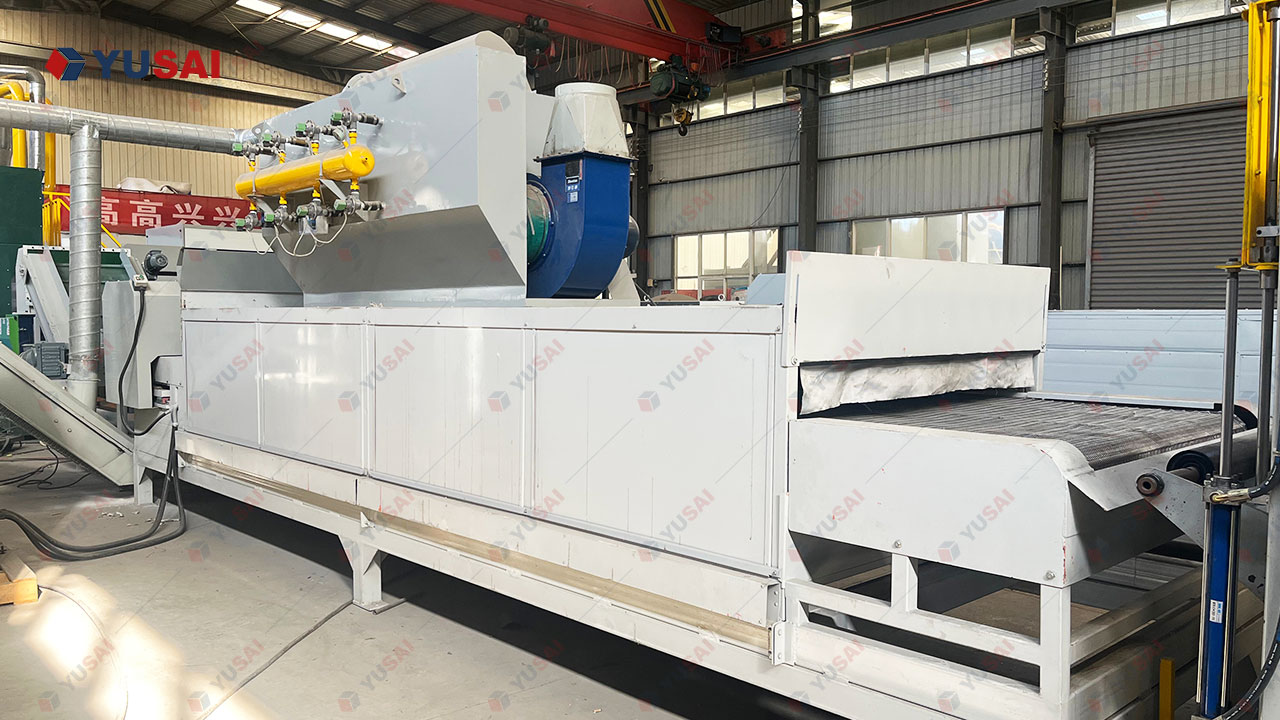
Solar Panel Glass Removing Machine is a high-efficiency PV module recycling machine that separates the tempered glass layer from end-of-life or defective solar panels. Through precise infrared heating and mechanical peeling, it softens the EVA encapsulation film and strips the glass cleanly, achieving a glass recovery rate and purity of over 99% without damaging the silicon cells.
Fully automated with PLC touch-screen control, it operates as a zero-chemical, low-noise physical process with integrated dust collection — a one-operator solution for the glass removal stage of any solar panel recycling line.
Product Overview
What is a solar panel glass removing machine?
A solar panel glass removing machine (also called a solar panel glass removal machine, PV panel deglassing machine, or glass stripping machine) is the core pre-treatment equipment of a solar panel recycling plant. It separates the front tempered glass layer from the rest of the PV module after the aluminum frame and junction box have been removed.
Glass accounts for approximately 65%–70% of a solar panel’s total weight — the single largest recoverable material stream in any decommissioned photovoltaic module. However, the glass is firmly bonded to the solar cells through a heat-laminated EVA (ethylene-vinyl acetate) film, which makes manual separation slow, labor-intensive, and lossy. Manual removal typically damages both the glass and the cells, destroying value in both streams.
Yusai Machinery’s automatic solar panel glass removing machine solves this problem with a thermal-softening + mechanical peeling design:
- The frame-removed panel is fed onto a conveyor automatically.
- A precision heating section softens the EVA adhesive layer without melting or carbonizing the cells.
- Heavy-duty wear-resistant alloy scraper blades peel the tempered glass away from the cell/backsheet sandwich in one clean pass.
- The separated glass cullet drops into a collection hopper, and the remaining glass-free panel (cells + backsheet) is discharged for the next recycling stage — crushing & sorting, pyrolysis, or silver extraction.
The result: clean, high-purity glass cullet for the glass industry, and an intact cell layer whose embedded silver, copper and silicon retain their full recovery value. As one of the leading solar panel recycling equipment manufacturers in China, Yusai integrates this machine into complete turnkey solar panel recycling lines — from frame removal to silver ingot.
Recycling Value Analysis
1. Why solar panel recycling is a growing business
Photovoltaic modules have a service life of roughly 25–30 years. With the global solar boom of the 2010s, the first large wave of end-of-life (EOL) solar panels is now arriving, and the volume will accelerate sharply through the 2030s. According to IRENA’s widely cited projections, cumulative global PV panel waste could reach 78 million tonnes by 2050 — creating both a regulatory obligation and a large secondary-raw-material market. Industry estimates place the cumulative value of recoverable raw materials from PV panels at US 450million by 2030 and more than US 450 million by 2030 and more than US15 billion by 2050.
2. What is inside a solar panel (by weight)
By weight, a typical crystalline silicon solar panel is composed of:
- Tempered glass (front sheet) — about 65–70% of the panel weight. Recovered by the glass removing machine. Unit price is low but volume is huge, and clean cullet resells as secondary glass raw material.
- Aluminum (frame) — about 10%. Removed by the frame removal machine. The market is mature and the material is ~100% recyclable — the strongest immediate profit point of a recycling line.
- Silicon (cells) — about 3–5%. Recovered through crushing/sorting and refining. Industrial-grade silicon costs about $2 per kilogram, while solar-grade silicon can cost around $25 per kilogram.
- Copper (ribbons and busbars) — about 1%. Recovered through crushing/sorting and electrostatic separation, with 95%+ recovery and ≥95% purity.
- Silver (finger electrodes) — less than 0.1%. The highest per-gram value in the panel; recovered through refining as 99.99% silver.
- EVA film and backsheet (plastic) — about 10%. Separated by air classification after crushing and recycled as plastic powder.
3. Where the glass removing machine makes its money
- Glass is the volume play: one ton of panels yields roughly 650–700 kg of glass. Even at modest per-ton glass prices, this is the largest cash-flow stream by weight — but only if the glass is recovered whole and clean. Crushed/dirty glass sells at a discount; ≥99%-purity cullet commands premium prices as secondary raw material for glass manufacturing.
- Protecting the high-value streams: a non-destructive glass removal keeps cells and copper ribbons intact, so the downstream extraction of silver, copper and silicon (which hold most of the total panel value) is not lost to glass contamination.
- Compliance monetization: in the EU (WEEE), India (EPR), and other regulated markets, proper PV recycling turns a legal liability into a certified revenue stream.
Payback logic: a 50–60 pcs/h glass removing machine, paired with a complete recycling line, typically processes 1–3 tonnes of panels per hour. Most small-to-mid scale recyclers recover their equipment investment within 12–24 months through combined glass, aluminum, copper, silicon and silver sales.
Applicable Materials
The Yusai automatic solar panel glass removing machine is compatible with the mainstream PV module types found in today’s recycling feedstock:
- Monocrystalline silicon panels — fully compatible; the most common end-of-life feedstock worldwide.
- Polycrystalline silicon panels — fully compatible; standard 60-cell and 72-cell layouts.
- Bifacial / double-glass panels — supported with a dedicated double-glass processing line configuration.
- Thin-film panels — available on request; contact us for a dedicated solution.
- Broken or cracked panels — panels with minor cracks can be processed (manual adjustment or automatic mode); severely shattered glass is better handled by a dedicated shredding line.
Handling size range: Length 1000–2500 mm, Width 600–1400 mm (machine settings adjustable; customized sizes on request).
Pre-condition: panels must have the aluminum frame and junction box removed first (upstream Yusai frame removal machine / junction box removal machine available). Frame-removed panels with flat, uncurled edges deliver the best separation result.
Product Structure (Main Equipment)
The solar panel glass removing machine is a compact, self-contained unit built on a welded heavy-duty steel frame. Main structural modules:
Main structural modules:
- Automatic conveyor feeding system — transports frame-removed panels into the machine at a set speed; roller spacing is adjustable for different panel lengths.
- Infrared heating / thermal softening section — a precision PID-controlled infrared heating zone softens the EVA encapsulation film (typically 120–180°C, adjustable) without melting or carbonizing the silicon cells.
- Mechanical peeling & stripping unit — high-strength, wear-resistant alloy scraper blades and a multi-stage knife-roller group apply balanced gradient shear force to peel the tempered glass cleanly and non-destructively.
- Glass cullet collection hopper — receives the separated glass fragments; an integrated discharge conveyor is optional.
- Panel discharge section — discharges the glass-free panel (cells + backsheet) to the next stage, such as a crushing & sorting line or a pyrolysis line.
- PLC control cabinet + touch screen — Siemens/Delta PLC with HMI touch panel for one-button operation, parameter memory and fault alarm display.
- Dust & fume extraction system — integrated negative-pressure dust collection captures particulates from the heating and peeling process; closed operation with no dust leakage.
- Safety guard system — fully enclosed guards, emergency stop buttons, overload protection and residual-current protection.
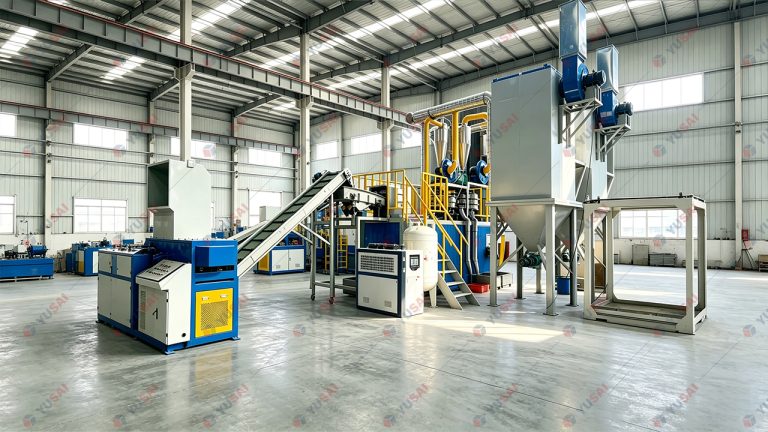
Upstream & downstream integration: the machine is designed modularly and can be combined with Yusai’s automatic solar panel frame removing machine, junction box removing machine, crushing & sorting production line, pyrolysis tunnel furnace, and precious metal extraction equipment to form a complete turnkey solar panel recycling plant (50–60 pcs/h or 1000–2000 kg/h capacity).
Process Flow
Step-by-step working principle of the solar panel glass removal machine:
Feeding & Positioning — Frame-removed solar panels are loaded onto the conveyor automatically (or manually for low-capacity models). Sensors position the panel correctly before it enters the heating zone.
EVA Thermal Softening — The panel passes through the infrared heating section. Precise PID temperature control softens the EVA adhesive layer (the bonding between glass and cells), dramatically reducing the peeling force required — without melting the film or damaging the cells.
Mechanical Glass Stripping — The softened panel enters the peeling unit, where wear-resistant alloy blades / knife rollers apply balanced, even pressure and shear the tempered glass cleanly off the cell/backsheet layer. The glass comes off in large, high-purity fragments (glass cullet).
Glass Discharge — Separated glass cullet falls into the collection hopper, ready for direct resale as secondary glass raw material (purity ≥99%).
Remaining Material Discharge — The glass-free panel (silicon cells + copper ribbons + backsheet) is discharged and automatically fed to the next stage: crushing & sorting (for silicon/copper/plastic powder) or pyrolysis (for silicon wafers & silver extraction).
A working video of the glass removal process is available on request — contact us for a live demonstration link.
Product Features
Ultra-high recovery purity (≥99%) — glass is separated in whole or highly pure fragments without crushing, producing premium cullet that sells at top market prices.
Non-destructive processing — EVA cells, copper ribbons and backsheet stay intact for downstream precious metal extraction; zero damage to the valuable inner materials.
Precise temperature control — PID-controlled infrared heating softens the EVA film consistently across the full panel width, even in cold climates or with aged, brittle EVA.
Universal compatibility — adjustable settings process various panel sizes and layouts, from 60-cell to 72-cell modules, including bifacial (double-glass) panels on request.
Eco-friendly operation — zero chemicals, low noise, integrated dust collection; the system runs as a closed, negative-pressure operation with no dust leakage — helping recycling plants pass local environmental assessments (EIA).
Labor-saving automation — PLC + touch screen one-button operation; a single operator manages the whole machine, cutting labor costs by up to 70% compared with manual glass removal.
Safety-first design — fully enclosed guards, emergency stop, overload and residual-current protection protect operators from residual photovoltaic charge and flying glass debris.
Modular & scalable — works as a standalone unit or integrates into a complete automated solar panel recycling line; capacity expandable from 50 pcs/h up to full production plants.
Technical Parameters
| Parameter | Specification |
|---|---|
| Model | YS-PV-GRM1500 / YS-PV-GRM2200 |
| Processing capacity | 50–60 panels/hour (approx. 1–2 t/h depending on module size) |
| Glass recovery rate | ≥99% |
| Glass purity (cullet) | ≥99% |
| Applicable panel size | Length 1000–2500 mm; Width 600–1400 mm |
| Panel type | Monocrystalline / polycrystalline silicon PV modules; bifacial on request |
| Total power | 15–22 kW |
| Voltage supply | 380V / 50Hz / 3-phase (415V, 480V, 60Hz customizable) |
| Air pressure (if pneumatic) | 0.6–0.8 MPa |
| Machine weight | Approx. 2,500 kg |
| Operation control | PLC + touch screen (Siemens/Delta) |
| Heating temperature | 120–180°C (PID adjustable) |
| Dust control | Integrated negative-pressure dust collection system |
| Working noise | Low-noise design (meets workshop standards) |
Note: Working voltage, capacity and panel size can all be customized. Data in this table is for reference only — contact our engineers for a solution matched to your feedstock and target capacity.
Advantages
Why choose Yusai Machinery’s solar panel glass removing machine over other manufacturers?
- ≥99% glass purity, vs. the industry-standard 85–95%. Many suppliers quote 85–95% glass removal at ≥90% purity. Our thermal + peeling design delivers ≥99% recovery and ≥99% purity, so your glass cullet sells at the premium grade price instead of the discount grade.
- Zero cell damage. Non-destructive peeling keeps the silicon cells and copper ribbons intact, protecting the silver, copper and silicon value that accounts for most of a panel’s total worth.
- Complete in-house line integration. We manufacture the whole chain ourselves — frame removal, glass removal, crushing & sorting, pyrolysis and silver refining — one supplier, one responsibility, perfectly matched capacities.
- Factory-direct pricing, with OEM/ODM experience since 1995. No middlemen; 20+ years of R&D and manufacturing, serving customers in more than 60 countries and regions.
- Proven quality system. ISO 9001 quality management, CE-certified components, and a 24-hour load test before every shipment.
- Fast return on investment. Combined with the full recycling line, most clients recover their investment within 12–24 months through glass, aluminum, copper, silicon and silver sales.
- Global after-sales network. Installation and commissioning, operator training, 12-month warranty, lifetime technical support and 24-hour online service.
Service Process
From first inquiry to production, Yusai provides a complete one-stop service process:
- Consultation & requirement analysis — tell us your raw material type, daily tonnage, target products, budget and project timeline.
- Sample testing — send us a sample of your solar panels; we run a free test in our lab and issue a testing report to help you analyze project feasibility and expected recovery rates.
- Solution design — our engineers design the complete line layout (free layout design), recommend the right model combination, and provide a process flow chart.
- Quotation & financial proposal — detailed quotation, payment terms (e.g. 30% T/T deposit), and a financial/market analysis to support your investment decision.
- Production & progress updates — production starts after confirmation; you receive photo/video progress updates throughout manufacturing.
- Pre-shipment testing & video acceptance — 24-hour load test with video sent for your approval before packing.
- Shipping — on-time delivery via sea/air, with full shipping documentation (packing list, commercial invoice, certificate of origin, etc.).
- Installation & commissioning — optional engineer dispatch or remote video-guided installation and commissioning.
- Operator training — manuals, video tutorials and on-site training (for larger orders) so your team achieves full efficiency from day one.
- Lifetime after-sales support — spare parts supply, technical upgrades, and 24-hour online service.
Warranty & After-Sales Service
- 12-month warranty on the complete machine, starting from the date the client signs the acceptance certificate.
- Lifetime technical support and free technology upgrading advice from our R&D department.
- Spare parts supply — all wearing parts (blades, heating elements, sensors, PLC modules) are available at cost price for the lifetime of the machine.
- 24-hour online service — WhatsApp / email / video support; most technical issues are resolved remotely within one working day.
- Engineer dispatch — for larger plants, our engineers travel to your site for installation, commissioning and team training.
- EIA / compliance guidance — we assist clients in preparing environmental assessment documents where required by local regulations.
Precautions
Operator safety:
- Residual electricity: solar panels can retain electrical charge even when disconnected. Always discharge modules and confirm zero voltage before feeding; never touch exposed conductors or cut cables under load.
- Personal protection: operators must wear protective gloves, safety goggles and work shoes. Glass fragments and sharp edges can cause serious cuts.
- Heat zone: the infrared heating section operates at 120–180°C — keep hands and loose clothing away from the heating area and discharge points.
- Emergency stop: ensure all operators know the location and use of the emergency stop button.
Operation & maintenance:
- Feedstock pre-condition: remove the aluminum frame and junction box before feeding; panels with severely shattered glass should be diverted to the shredding line.
- Daily checks: inspect conveyor alignment, blade wear, heating element condition and dust collector bags before each shift.
- Regular maintenance: follow the maintenance manual — lubricate rollers, replace worn blades in time, and keep sensors and touch screen clean.
- Electrical safety: ensure proper grounding; keep the control cabinet closed; have a qualified electrician perform any electrical work.
- Environment: install the machine on a level floor with adequate ventilation and lighting; keep the working area dry and free of obstacles.
Frequently Asked Questions (FAQ)
Q1. What is a solar panel glass removing machine?
A solar panel glass removing machine is a PV module recycling machine that separates the front tempered glass layer from the solar cells of end-of-life or defective solar panels. It uses precise heating to soften the EVA adhesive film, then mechanical blades peel the glass off cleanly, achieving a glass recovery rate and purity of over 99%.
Q2. Do I need a frame removal machine before the glass removing machine?
Yes. The glass removing machine works best after the aluminum frame (and junction box) have been removed. If you don’t have one yet, we also supply the automatic solar panel frame removing machine and junction box removing machine as part of a complete line.
Q3. What is the glass recovery rate and purity?
Our machine achieves a glass recovery rate of ≥99% and a glass cullet purity of ≥99% — significantly higher than the 85–95% removal / ≥90% purity typical of conventional equipment. High-purity cullet sells at premium prices.
Q4. Does the machine damage the solar cells?
No. The EVA film is softened by precise temperature control (120–180°C) before peeling, and the scraper blades apply balanced, even pressure. The silicon cells, copper ribbons and backsheet remain intact for downstream silver/copper/silicon recovery.
Q5. Can it handle broken or cracked panels?
Panels with minor cracks can be processed normally (with manual adjustment if needed). For severely shattered glass, we recommend a separate crushing & sorting line — our engineers will advise based on your actual feedstock.
Q6. How many panels can it process per hour?
The standard YS-PV-GRM1500/2200 models process 50–60 panels per hour (approx. 1–2 t/h depending on module size). Higher-capacity configurations and complete lines up to 1000–2000 kg/h are available.
Q7. Which solar panel types are supported?
Monocrystalline and polycrystalline silicon PV modules in mainstream sizes (length 1000–2500 mm, width 600–1400 mm). Bifacial / double-glass panels are supported with a dedicated configuration — contact us for details.
Q8. What happens to the remaining material after glass removal?
The glass-free panel (silicon cells, copper ribbons, backsheet) is automatically discharged to the next stage: a crushing & sorting line (producing silicon powder, copper powder, plastic powder) or a pyrolysis tunnel furnace (producing silicon wafers and copper wire), followed by silver extraction — recovering up to 99.99% silver.
Q9. How much does a solar panel glass removing machine cost?
What is the ROI? Price depends on capacity, configuration and customization. As a factory-direct manufacturer we offer competitive pricing; payment is typically 30% T/T deposit with the balance before shipment. Most small-to-mid recyclers recover their investment within 12–24 months through combined glass, aluminum, copper, silicon and silver sales. Contact us with your tonnage and target output for an exact quotation and payback analysis.
Q10. Do you provide installation, training and after-sales service?
Yes. We provide installation & commissioning (engineer dispatch or remote guidance), operator training (manuals, video tutorials, on-site training for larger orders), a 12-month warranty, lifetime technical support, spare parts at cost, and 24-hour online service.
Q11. Can this machine integrate with my existing recycling line?
Yes. The machine is modular and can be retrofitted into existing lines or combined with our complete solar panel recycling plant (frame removal → glass removal → crushing/sorting → pyrolysis → silver refining). We provide free layout design to match your site.

Get A Free Quote
Fill in the form below and our service team will get back to you within 24 hours with a recommended process flow and quotation.
- +86 18339216321
- info@yusaipreciousmetals.com
- Zhengzhou.Henan.China
- Solar Panel Recycling Plant
- Solar Panel Pyrolysis Recycling Plant
- Solar Panel Junction Box Removing Machine
- Solar Panel Aluminum Frame Removing Machine
- Solar Panel Glass Removing Machine
- Solar Panel Pyrolysis Tunnel Furnace
- Solar Panel Pyrolysis Sorting System
- Solar Panel Crushing Sorting System
- Silver Stripping Machine
If you be interested in our equipment and solutions, please to contact us.
- +86 18339216321
- info@yusaipreciousmetals.com
- zhengzhou.henan.china