As solar PV capacity expands worldwide under the net‑zero carbon goal, massive volumes of photovoltaic panels will reach their end‑of‑life in the coming years. If improperly disposed of, retired solar modules release hazardous substances and create environmental risks; meanwhile, high‑value materials including silver, copper, silicon, aluminium and glass are lost to landfills. For PV manufacturers and exporters trading into European markets, understanding the EU WEEE Directive, Extended Producer Responsibility (EPR) rules and mainstream recycling technologies has become essential to mitigate overseas trade risks and build circular‑economy competitiveness.
1. EU WEEE Directive: Core Regulatory Framework for PV Waste
The Waste Electrical and Electronic Equipment Directive (WEEE 2.0, Directive 2012/19/EU) sets the world’s most complete legal system for waste photovoltaic modules, placing PV products under Category 4 of electrical‑electronic waste management.
Key Recovery & Recycling Targets
Since August 15, 2018, legally binding performance thresholds apply for waste PV modules across EU member states:
- Recovery rate: minimum 85 % by weight of input waste modules
- Recycling rate: minimum 80 % by weight for material reuse (excluding energy‑only recovery or back‑filling operations)
Definition note
- Recovery: any operation diverting waste for useful economic purposes;
- Recycling: re‑processing waste into new materials or products, excluding fuel conversion or land‑fill backfill.
Under the EPR principle, producers bear primary legal responsibility, not end‑users. Responsible parties cover manufacturers, importers, distributors, installers and cross‑border e‑commerce sellers placing PV panels on EU national markets. Mandatory obligations include:
- Register as a WEEE producer in target EU member states
- Submit regular sales‑volume reports to local regulators
- Mark products with official WEEE labels and inform buyers of correct waste‑disposal procedures
- Fund collection, logistics and treatment for current and future retired PV hardware
- Disclose module composition and hazardous‑substance data to authorised recycling facilities
Most manufacturers fulfil duties by joining authorised non‑profit Producer Responsibility Organisations (PROs), also called compliance‑recycling schemes. Well‑known examples are PV CYCLE (Belgium, Europe’s largest PV compliance scheme), SOREN (France) and Stichting OPEN (Netherlands). National compliance costs differ country‑by‑country, covering registration fees, guarantee deposits, annual contributions, administration and actual waste‑treatment charges. In Belgium and France, end‑users receive free collection and handling for end‑of‑life PV panels through these schemes.
Product eco‑design requirements also apply: manufacturers must integrate disassembly, recyclability and end‑of‑life handling considerations from the R&D and production phase, following full‑lifecycle design philosophy.
2. Up‑coming Wave of Retired PV Modules: Market Outlook
End‑of‑life PV modules come from two major streams:
- Supply‑side waste: damaged panels during manufacturing, storage and transportation
- Application‑side waste: defective panels from site installation; degraded operating panels suffering hot‑spot damage or back‑sheet ageing; full‑life retirement after 20‑25‑year service; early‑stage technical retrofits replacing old low‑efficiency modules (many of these old panels qualify for direct second‑life reuse).
Based on historical global PV installation statistics, the first noticeable retirement wave starts around 2025, with accelerating growth through 2028‑2030; the peak decommission volume may arrive earlier than the theoretical 25‑year cycle as more plants implement technical upgrades.
Forecasted waste capacity (including manufacturing, transport and installation scrap, excluding second‑life retrofit stock):
- 2025: total global waste PV modules ~1 GW
- 2030: total global waste PV modules ~2.3 GW
In weight terms, taking average module weight ~40 tons/MW (differentiating single‑glass and double‑glass products):
- 2025 global waste module weight reaches 52 800 tons
- 2030 global waste module weight will hit 115 900 tons
Crystalline‑silicon PV module material weight breakdown: glass ~78 %, aluminium frame ~10 %, polymer plastics ~7 %, metals & semiconductor materials ~5 %. Glass, aluminium, silicon, silver and copper deliver the highest recycling economic value.
3. Mainstream Industrial Recycling Technologies for Crystalline‑Silicon PV Panels
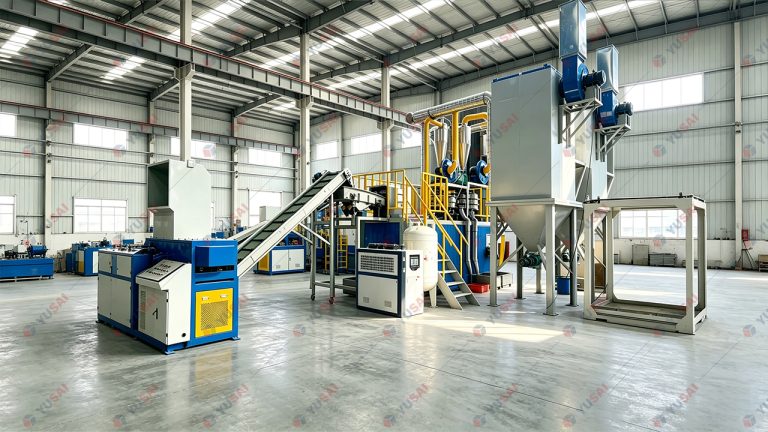
Recycling workflows generally consist of two core phases: component disassembly and material separation. Three primary technical routes are currently applied in labs and pilot‑scale factories.
3.1 Mechanical Physical Shredding
Modules are crushed into granular fractions. Glass particles and solder ribbons get sorted out, residual material goes through grinding and electrostatic separation to isolate metals, back‑sheet fragments and EVA/POE encapsulant residues.
- Lab‑scale performance: total mass recovery ~91.2 %, silver ~91 %, silicon ~95.1 %, copper ~95.2 %
- Drawback: separated metal fractions carry impurity content, limiting final metal recovery yield to roughly 17.4 % in some practical scenarios.
3.2 Pyrolysis / Thermal Decomposition
Low‑temperature heating softens EVA or POE encapsulant for layer separation. High‑temperature pyrolysis fully decomposes organic encapsulation layers, with >99 % removal efficiency for EVA/POE; this solution has already been adopted by several real‑world recycling enterprises.
- Lab‑scale performance: total mass recovery ~90.2 %, silver ~93.76 %, silicon ~96.27 %, copper ~99 %
- Note: exhaust gas from organic decomposition must be treated properly to avoid secondary air pollution.
3.3 Chemical Soaking Method
Organic solvents dissolve and oxidise EVA / POE layers to release intact silicon wafers, achieving silicon‑material recycling rate higher than 90 %.
- Weakness: poorly‑controlled solvent reactions may over‑swell encapsulant layers and crack solar cells. Waste‑liquid treatment brings high operational barriers for large‑scale commercial roll‑out.
No single recycling technology has achieved fully mature large‑scale commercial profitability across the whole industry today. Pilot production lines and continuous technical optimisation remain necessary before mass deployment.
4. Practical Recommendations for PV Export Enterprises
Against incoming massive PV‑module retirement and tightening EU green trade rules, forward‑looking layout of circular‑economy capacity brings differentiated competitive advantages and lowers compliance‑penalty and reputational risks for solar manufacturers:
- Build pilot recycling lines at existing manufacturing bases: carry out full economic verification of recycling workflows ahead of market maturity.
- Participate in formulation of recycling‑related standards: combine product R&D with recyclable eco‑design, strengthen brand communication on circular‑economy credentials and secure market initiative.
- Master EU WEEE & EPR compliance requirements before exporting: select qualified local PRO compliance‑recycling schemes for each target EU country, complete producer registration and fulfil reporting obligations.
- Explore both domestic and overseas recycling business models: evaluate the feasibility of second‑life reuse for early‑retired modules alongside material‑recovery pathways, and seek viable long‑term profit models for PV circular value chains.
Closing
The global solar industry cannot ignore the “last mile” of PV‑module lifecycle management. By respecting EU WEEE regulatory requirements, investing in recycling‑technology R&D and practising extended‑producer‑responsibility rules, PV suppliers can support global carbon‑neutrality targets while reinforcing their leading market position in international solar trade.