As global renewable‑energy deployment accelerates, massive volumes of solar PV panels are approaching their end‑of‑service life. Efficient photovoltaic recycling is becoming indispensable to achieve environmental sustainability, conserve critical raw materials, comply with international waste regulations and unlock new economic value across the solar industryUnited Sta….
Opportunities & Challenges of PV Panel Recycling
Recycling retired solar panels delivers prominent benefits: conserving finite mineral resources, cutting landfill waste and lowering overall carbon footprints, while opening new commercial revenue streams and helping businesses meet local environmental compliance standards.
Nevertheless, practical recycling still faces multiple obstacles: complex material separation requirements, high initial capital investment, insufficient local recycling infrastructure in many regions, and safety risks when managing trace hazardous components inside modules. Even so, the long‑term gains outweigh these drawbacks, making PV recycling a core pillar of a sustainable clean‑energy future.
A solar panel contains multiple high‑value recyclable substances including silicon, aluminium, silver, copper and rare metals. Most weight fractions of a spent module can be recovered and fed back for manufacturing new PV panels or electronic parts. By weight, a typical crystalline‑silicon PV module consists of approximately 70% glass, 10% aluminium frame, 10% encapsulating sealant materials, 5% silicon, plus small percentages of silver, indium, gallium and other constituents. For standard framed crystalline‑silicon modules, the average material recycling rate can reach up to 94% with proper processing.
When Should Solar Panels Be Recycled?
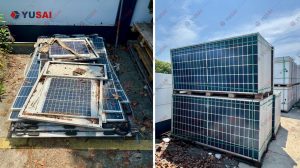
PV panels generally operate effectively for 25‑30 years before performance degradation sets in. Recycling is recommended under these scenarios:
- End‑of‑service lifecycle: Power output drops substantially after decades of field operation.
- Severe technical failure: Irreparable cell damage or critical electrical faults render repair uneconomical.
- System upgrade: Replacing old modules with higher‑efficiency new‑generation solar panels.
- Disaster‑related damage: Panels broken by storms, floods or other catastrophic events beyond restoration.
- Regulatory obligations: Local legal requirements mandating proper waste handling for photovoltaic waste.
Responsible recycling prevents improper dumping, recovers valuable raw materials and minimises ecological harm.
Why Recycle Photovoltaic Panels?
Environmental Protection
Diverting end‑of‑life panels away from landfills avoids soil and groundwater contamination. As recycling techniques mature, the economic viability of recovered materials keeps improving.
Circular Resource Supply Chain
Silicon, aluminium, silver, copper and rare metals extracted from old modules can be reused in production. Recycling builds closed‑loop material cycles and eases reliance on virgin mineral mining.
Additional Economic Returns
Recovered secondary materials generate tangible revenue, offsetting collection and processing expenditures for recycling operations.
Global Market Practice for PV Recycling
Europe has taken the lead in establishing commercial PV recycling frameworks. France launched Europe’s first dedicated PV recycling plant in cooperation with industry organisations back in 2018, and the world’s first full‑recovery PV recycling facility opened in 2023 targeting 99% material extraction from modules. In Germany, non‑profit industry organisations coordinate nationwide collection, dismantling and material recovery to satisfy environmental legislation. Italy implements producer‑financed waste management policies: for small‑scale residential PV installations below 10 kW, module disposal costs are proportionally covered by panel manufacturers according to their market share.
Composition & Recyclable Value of PV Modules
A crystalline‑silicon solar panel is assembled from tempered glass, aluminium frame, EVA encapsulant, silicon solar cells, silver conductive paste, copper ribbons, polymer backsheet and junction‑box wiring. Each component carries distinct recycling value and recovery difficulty:
- Glass (75‑80 % weight share): Low per‑unit market value; mature recovery technology, requiring thorough separation from cell layers.
- Aluminium frame (5‑10 %): Good market value; well‑established melting‑reuse recycling workflows.
- Silicon wafers (5‑10 %): Medium‑to‑high recovery value; needs refining after separation from encapsulant.
- Silver, copper & tin traces: High‑value precious and base metals; demands specialised metallurgical purification.
- EVA encapsulant & polymer backsheet (10‑12 %): Low‑material‑value organics; can be utilised for energy recovery.
Core Recycling Workflows for PV Panels
Crystalline‑Silicon Panel Recycling
- Dismantling frames & junction boxes: Mechanically remove aluminium frames and electrical accessories for direct metal re‑melting.
- Separate glass from silicon cells: Adopt thermal, mechanical or chemical approaches to decouple glass laminates; up to 95 % glass can be reclaimed.
- Thermal treatment: Process laminates around 500 °C to vaporise EVA encapsulant; waste heat can be recovered for plant energy supply.
- Purify silicon and metallic fractions: Apply chemical and physical metallurgy to refine silicon wafers and metal concentrates. Purified silicon may return to solar‑cell manufacturing, while metals serve high‑tech industrial applications.
Two mainstream industrial processing routes are widely applied for crystalline‑silicon modules:
- Crushing‑based recycling: Receive incoming panels → pre‑dismantling → crushing & screening → air classification → density/flotation separation → eddy‑current sorting to split glass, metals, semiconductors and polymer fractions.
- Delamination‑based recycling: Receive panels → pre‑dismantling to strip frames and cables → delamination treatment → thermal processing → mild chemical treatment, followed by multi‑stage sorting to sort out glass, silver, aluminium, plastic and semiconductor‑rich fractions.
Thin‑Film Panel Recycling
- Crushing and fine milling: Feed modules into crushers and hammer mills to reduce material into 4‑5 mm fine particles.
- Solid‑liquid separation: Use rotary screw equipment for phase separation, followed by sedimentation and dehydration.
- Recover semiconductor materials: Metallurgical separation retrieves around 95 % of semiconductor content.
- Glass recovery: Washing and vibration screening recover up to 90 % glass ready for remanufacturing.
AI‑Powered Intelligent PV Recycling System
Next‑generation container‑sized intelligent recycling systems bring revolutionary upgrades for photovoltaic waste treatment. Integrated with computer vision and machine‑learning algorithms, this fully‑physical processing solution avoids chemical reagents and external heating.
Key System Capabilities
- High total recovery: Achieve near‑100 % material recovery rate covering solar cells, EVA adhesive layers, fluorine‑containing backsheets, aluminium frames, glass and junction‑box parts. Recovered fractions maintain high purity for downstream circular‑economy reuse, addressing the pollution risk posed by the residual 20 % waste output of conventional e‑waste recycling standards (80 % minimum recovery).
- Compact containerised layout: Fits within standard 40‑foot container dimensions for flexible on‑site deployment and capacity scaling.
- High‑throughput fully‑automatic operation: Processes approximately one panel per minute with zero manual intervention; annual processing capacity reaches 10 000 tons.
- Low‑energy physical‑only treatment: Consumes merely 5 kWh electricity for each processed panel; no process water or consumable chemicals required. It delivers significant carbon‑emission reduction and substantial operational‑cost savings.
- AI self‑optimisation: Visual AI identifies incoming panel varieties; machine learning dynamically adjusts feeding and separation parameters. Over‑the‑air cloud updates continuously optimise processing logic for evolving panel types.
Application Value
By maximising material purity, intelligent recycling improves the market value of secondary raw materials, balancing environmental protection and commercial profitability. This eco‑friendly physical‑only technology complies with tightening global restrictions on thermal and chemical recycling methods.
Outlook
With the approaching wave of large‑scale solar‑panel retirement worldwide, advanced automated PV recycling equipment creates reliable infrastructure for the solar circular economy. Closed‑loop resource recovery not only cuts the carbon footprint of photovoltaic manufacturing but also helps industry participants meet global waste directives, opening profitable new business opportunities in the renewable‑energy value chain.